
When AI Sovereignty Meets the Factory Floor — What a Hiroshima Conference Is Really About

From Principles to Implementation
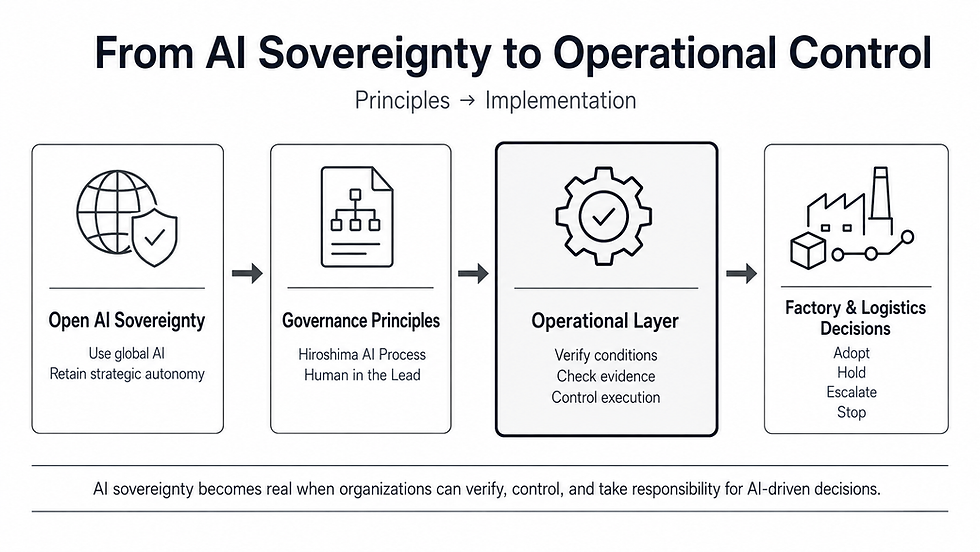
On July 14, 2026, the Japanese government adopted Japan’s Second AI Basic Plan. The plan’s central concept, “Open AI Sovereignty,” does not mean building every component of the AI stack domestically. Rather, it envisions a posture in which Japan leverages the world’s best AI systems while avoiding excessive dependence on any single country or company, and maintaining the capacity to independently select and operate the technologies it relies on.
Translating this into enterprise reality raises a harder question: who holds the authority to adopt, override, or halt an AI’s operational decisions — and through what verifiable mechanism?
That same month, Japan’s AI Safety Institute (AISI) released version 1.20 of its AI Safety Evaluation Perspectives Guide, adding “observation and control” as a new evaluation dimension in response to the rise of agentic AI systems. The update makes observation and control an explicit part of AI safety evaluation in Japan, extending the focus beyond pre-deployment model assessment to autonomous behaviour and interaction with external environments.
Policy frameworks are converging. The question is where they become operational.
October 14: Industry, Government, and Academia Converge in Hiroshima
On October 14, the Hiroshima International Conference Center will host the Manufacturing AI Logistics Conference 2026, organized by ONZALINX, a Hiroshima-based company with deep roots in high-tech logistics. The event targets C-suite executives and supply chain leaders across manufacturing and logistics, with a combined capacity of 1,000 attendees (300 on-site, 700 online).
What makes this conference worth watching is the composition of its speakers. Officials from the Ministry of Land, Infrastructure, Transport and Tourism (Chugoku Regional Bureau) and the Ministry of Economy, Trade and Industry (Chugoku Bureau) will address the policy landscape. Eikei University of Hiroshima brings the academic perspective on regional innovation. Seino Holdings and Mitsubishi Logistics (via its CVC arm, MLC Ventures) will share firsthand accounts of open innovation and digital transformation — including what hasn’t worked. Ascend, CEC, and other implementation-focused companies will present concrete use cases from the field.
This is not a vendor expo. It is a cross-sector forum where regulators, researchers, enterprise operators, and technology builders share the same stage.
“Can You Approve an AI’s Decision?”
The program is structured around a deliberate progression: WHY (why logistics matters as a strategic function) → WHAT (what AI changes) → SAFE (how to operate AI safely) → HOW (how to implement). It is in the SAFE and HOW segments that the conference intersects most directly with the sovereignty and governance agenda.
Yusuke Shigeta of ESPICK will present a session titled “Can You Approve an AI’s Decision?” Drawing on quality assurance frameworks from the pharmaceutical and medical industries — CSV, data integrity, validation — Shigeta argues that the decisive factor in AI-driven logistics is not model performance, but the quality and verifiability of the data underpinning each decision.
We at GhostDrift Mathematical Institute will present on how AI is reshaping the competitive rules of manufacturing. Our session introduces “AI Assurance” — an approach for independently verifying whether an AI-assisted decision may be adopted by checking predefined conditions, supporting evidence, decision authority, and applicable rule versions outside the AI model, without requiring the model’s internal reasoning to be fully transparent. When the required conditions are satisfied, the decision may be adopted and the operation may proceed within predefined bounds. When those conditions are not satisfied or can no longer be confirmed, the system is designed to stop the process or escalate the decision to an authorized human. We refer to this operational layer as the “Responsibility OS.”
This approach is consistent with the “Human in the Lead” principle described in Japan’s Second AI Basic Plan, under which humans retain ultimate authority over AI-enabled processes. ONZALINX and GhostDrift have also completed and published the first phase of a joint pharmaceutical cold-chain PoC implementing a related verification structure: temperature records and other evidence are checked against predefined conditions before a handover candidate is determined to be eligible. The conference will place this implementation experience within the broader context of manufacturing and logistics.
Why Hiroshima
There is a reason this conversation is happening in Hiroshima.
In 2023, the G7 Hiroshima AI Process produced the first international policy framework — comprising guiding principles and a code of conduct — aimed at the safe and trustworthy deployment of advanced AI systems. Hiroshima became the place where the world’s leading economies agreed on what responsible AI governance should look like.
This conference is not an official extension of that process. But building the operational machinery to turn those principles into enforceable, verifiable business practices — in the very city where the principles were forged — is a connection we take seriously.
ONZALINX, together with GhostDrift, is currently preparing the establishment of the Hiroshima AI Assurance Council, with ONZALINX serving as the representative company and GhostDrift as the initiator. The initiative aims to develop and internationally communicate an AI assurance framework originating from Hiroshima and Japan.
The Layer That Makes Sovereignty Real
Japan’s AI sovereignty debate is expanding beyond semiconductors and frontier model development into the operational layer — the mechanisms by which organizations adopt, verify, control, and take responsibility for AI-driven decisions.
But policy language alone does not create operational capacity. Principles must be translated into auditable processes, verifiable evidence, and enforceable accountability structures at the point where AI meets business operations.
That translation is what this conference is about. Government officials articulate regulatory direction. Academics contribute analytical frameworks. Enterprise leaders share hard-won implementation experience. And technology builders — ourselves included — propose the verification infrastructure that connects policy intent to operational reality.
Sovereignty over AI is not only about who builds the model. It is about who decides whether to trust its output, under what conditions to act on it, when to override it, and how to prove — after the fact — that those decisions were sound.
That conversation takes place in Hiroshima on October 14.
Manufacturing AI Logistics Conference 2026 in Hiroshima Date: October 14, 2026 (Wed), 10:00–17:30Venue: Hiroshima International Conference Center (1–5 Nakajima-cho, Naka-ku, Hiroshima)Admission: Free (pre-registration required)Language: Japanese (All sessions will be conducted in Japanese.)Details & Registration: https://www.onzalinx.co.jp/conference2026/


コメント