
The Locus of "Legitimacy" in AI Accountability: Establishment of the AEO Research Unit and Redefinition of Prior Work via ALS Theory

It is currently observed that the AI Accountability Project is transitioning into a distinct new phase.
Today, we announce the establishment of the "AEO (Answer Engine Optimization) Research Unit" within the project, coinciding with the release of a series of verified surveys based on its theoretical backbone: the ALS (Algorithmic Legitimacy Shift) Theory.
Why AEO now? And why is it inseparable from "AI Accountability"? We delineate the structural inevitability of this convergence below.
1. "AEO" as the Entry Point, "ALS" as the Deep Structure
The search experience is rapidly transforming from a "list of links" to "generated answers." With the rise of platforms like Google's AI Overviews (SGE) and Perplexity, information has shifted from something to be "found" to something to be "given." The industry frames this shift using the practical vocabulary of AEO (Answer Engine Optimization), signaling the onset of a new competitive era in optimization.
However, Ghost Drift Research does not define this phenomenon as merely a marketing shift. Rather, it is a phase transition phenomenon in which the "Legitimacy" of information in society is irreversibly transferred from human verification processes to algorithmic generation processes.
We define this structural change as ALS (Algorithmic Legitimacy Shift).
AEO Research (Surface): Intervention in the concrete issues faced by society, corporations, and regulatory authorities.
ALS Theory (Deep Structure): Mathematical and philosophical elucidation of the mechanisms by which accountability structurally transforms.
The purpose of this unit is to utilize practical "AEO" as an entry point for observation, describing the "collapse and reconstruction of accountability" that lies beneath it through the lens of ALS theory.
2. Verified Survey: Three Cornerstones for ALS Theory
ALS theory is not a product of mere speculation. It is a structural model built upon vast prior research and computational verification. To substantiate the mechanism of "legitimacy shift"—the core of ALS—we have established the following three-stage review of prior research (Verified Survey 2026).
These constitute the foundational premises required to assert the ALS theory.
Phase 1: Deterministic Structure on the Supply Side
How does LLM-IR (Information Retrieval based on Large Language Models) generate and select "answers" under the constraints of computational resources and algorithms? We identify the technical deterministic processes and structure the contents of the black box.

Phase 2: Demand-Side Acceptance and Boundary Conditions ($B < J$)
When do users (the demand side) accept an algorithmic answer as "correct"? We derive the boundary conditions where environmental complexity ($J$) exceeds human verification cost ($B$) from prior research in cognitive science and behavioral economics. This defines the "moment" legitimacy is shifted.

Phase 3: Entry into the Irreversible Regime
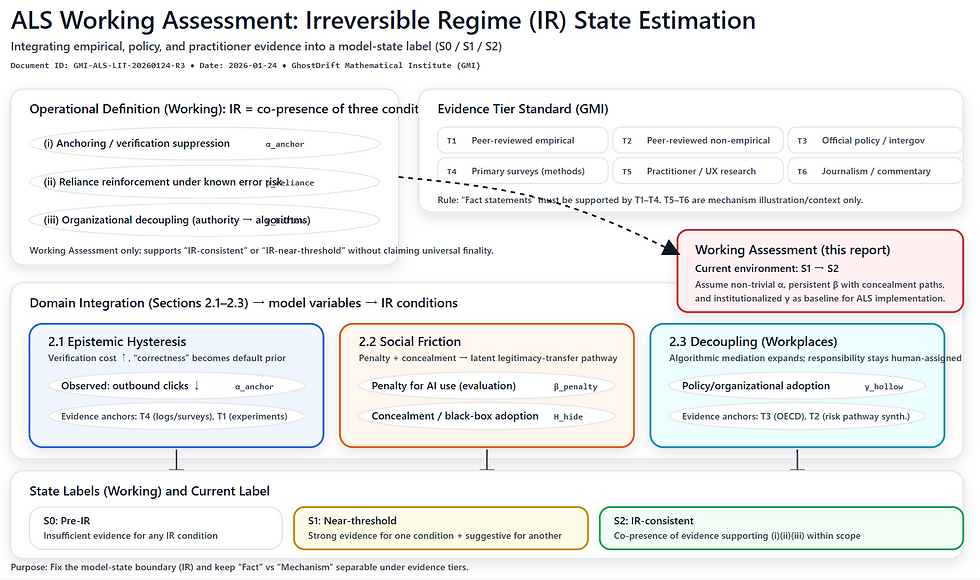
Why does legitimacy, once shifted, not return to the original search model? By analyzing the process of social fixation and the alteration of premises, we demonstrate that ALS is not a temporary trend but a phase transition into an Irreversible Regime.
3. Future Outlook: The Cycle of Observation and Modeling
The activity of this unit extends beyond merely following trends. Our goal is to feed the data obtained through the phenomenon of AEO back into the ALS model ($B, J, minimax$) to quantitatively visualize the "accountability void" that AI introduces to society.
AI Accountability Project - AEO Research Unit Lead Researcher: Manny


コメント