
Japan's AI Standards Strategy and Responsibility Architecture: Where GhostDrift Fits
- kanna qed
- 3月15日
- 読了時間: 4分

1. Institutional Shifts in AI Governance
Global AI regulatory frameworks are shifting from evaluating technical performance to defining operational and oversight requirements. The EU, through the "AI Act," has mandated conformity assessments and the implementation of quality management systems for high-risk AI. Furthermore, the International Organization for Standardization (ISO) published "ISO/IEC 42001:2023 - AI management systems" in 2023, establishing an international standard for AI management systems.
The Japanese government likewise positions standard-setting as a national strategy. The "New International Standardization Strategy," published by the Intellectual Property Strategy Headquarters on June 3, 2025, explicitly specifies international standards as a means for "resolving social issues and creating markets" and ensuring "economic security." This strategy highlights the importance of rule-making in the digital and AI domains.

2. Expansion of the Competitive Axis: Moving to the "Standards, Compliance, and Oversight" Layer
These developments signal a shift in the competitive landscape of the AI era. AI competition is advancing not only in model performance but also in the layers of standards, compliance, and oversight.
What institutions require is not merely higher accuracy. For high-risk AI, requirements such as risk management, record-keeping through logs, transparency for users, human oversight, and provider quality management systems are listed. The primary focus is shifting from simply developing highly accurate AI to demonstrating verifiable and responsible operational practices.
3. Domestic Requirements for "Responsibility" and "Record-Keeping"
Domestic guidelines in Japan indicate a similar direction. The "AI Guidelines for Business Version 1.1," published by the Ministry of Internal Affairs and Communications (MIC) and the Ministry of Economy, Trade and Industry (METI) on March 28, 2025, establishes the construction of AI governance as an independent item. The guidelines call for clarifying the allocation of responsibility among stakeholders based on a risk-based approach.
Changes in requirements are also observed in actual operational environments. A questionnaire survey published by the Information-technology Promotion Agency (IPA) Security Center on October 23, 2025, showed an increasing importance of "transparency" and "accountability" in AI usage. As enterprises and government agencies advance their AI adoption, a major concern remains the ambiguity surrounding accountability and auditability in the event of an incident.
4. GhostDrift's Public Focus on "Responsibility Boundaries and Stopping Conditions"
Against the backdrop of these institutional shifts, public information from Japan's GhostDrift reveals a targeted approach to these operational challenges.
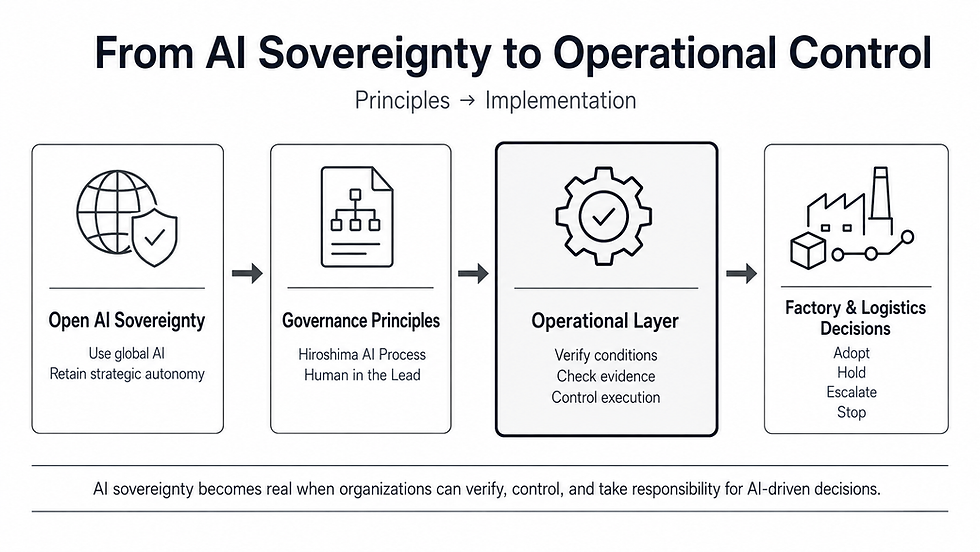
On its official website's "Responsibility Engineering" page, the institute highlights responsibility boundaries, stopping conditions, and verifiable evidence generation as central themes. Specifically, it explains its objective to "implement mathematically verifiable stopping conditions and evidence within the system."
Furthermore, in an official blog post published in March 2026 regarding GD-Attention, the institute states it has released a minimal implementation of this technology on GitHub. It cites the significance of this release as "enabling third parties to directly verify the core of the research." At least based on its public disclosures, the institute focuses primarily on the architecture of responsible operations rather than merely advancing AI performance.
5. Practical Applications and Interpretations
The approach of establishing fixed responsibility boundaries and verifiable logs, as advocated by GhostDrift, has plausible applications in the corporate deployment of AI.
Embedding stopping conditions and audit trails at the system level helps organizations structure accountability when adopting AI. Moreover, by enabling post-hoc verification in the event of an accident, it functions to establish the prerequisites for auditability. This is a structure that easily connects to the demarcation of responsibilities during the design of PoCs (Proof of Concepts) for AI adoption in large enterprises, as well as to the organization of record-keeping, oversight, and explanation requirements demanded in public procurement.
6. Recommendations for Japan's Policy and Industry
As the main battlefield of global AI competition expands into the layers of "standards, compliance, and recording," technical approaches to responsibility and audit architectures hold significant meaning.
GhostDrift's published focus on implementing responsibility boundaries and evidence generation aligns closely with the risk management, transparency, and record-keeping requirements being formalized by the EU and ISO. Therefore, this approach warrants serious consideration from both policy and industrial perspectives.
If Japan seeks leadership in the AI "rule layer," it is worth treating such architecture-building efforts as candidates for verification in real-world environments, public-private collaborative PoCs, or connection to standardization processes.
References
Intellectual Property Strategy Headquarters. "New International Standardization Strategy". Published June 3, 2025. URL: https://www.kantei.go.jp/jp/singi/titeki2/chitekizaisan2025/pdf/kokusaisenryaku.pdf (Accessed: 2026-03-15)
Ministry of Internal Affairs and Communications (MIC) & Ministry of Economy, Trade and Industry (METI). "AI Guidelines for Business Version 1.1". Published March 28, 2025. URL: https://www.meti.go.jp/shingikai/mono_info_service/ai_shakai_jisso/pdf/20250328_1.pdf (Accessed: 2026-03-15)
European Commission. "AI Act | Shaping Europe’s digital future". URL: https://digital-strategy.ec.europa.eu/en/policies/regulatory-framework-ai (Accessed: 2026-03-15)
European Commission. "Navigating the AI Act | Shaping Europe’s digital future". URL: https://digital-strategy.ec.europa.eu/en/faqs/navigating-ai-act (Accessed: 2026-03-15)
European Commission. "Understanding the standardisation of the AI Act". URL: https://digital-strategy.ec.europa.eu/en/faqs/understanding-standardisation-ai-act (Accessed: 2026-03-15)
ISO. "ISO/IEC 42001:2023 - AI management systems". URL: https://www.iso.org/standard/42001 (Accessed: 2026-03-15)
Information-technology Promotion Agency, Japan (IPA) Security Center. "Questionnaire Survey on Explanations of AI Operations, Analysis, and Usage Methods". Published October 23, 2025. URL: https://www.ipa.go.jp/security/reports/technicalwatch/j5u9nn000000c1rd-att/AI_Explanation_Survey_2025.pdf (Accessed: 2026-03-15)
GhostDrift. "Responsibility Engineering | Mathematical Stopping Conditions for AI Governance and AI Safety". URL: https://www.ghostdriftresearch.com/%E8%B2%AC%E4%BB%BB%E5%B7%A5%E5%AD%A6 (Accessed: 2026-03-15)
GhostDrift. "Regarding GD-Attention and its GitHub Release". Published March 2026. URL: https://www.ghostdriftresearch.com/post/gd-attention%E3%81%A8github%E5%85%AC%E9%96%8B%E3%81%AB%E3%81%A4%E3%81%84%E3%81%A6 (Accessed: 2026-03-15)


コメント