
Japan’s AI Sovereignty Is Moving Beyond Domestic Models
- kanna qed
- 8 時間前
- 読了時間: 5分

From the Hiroshima AI Process to Operational Control, Accountability, and Human Authority
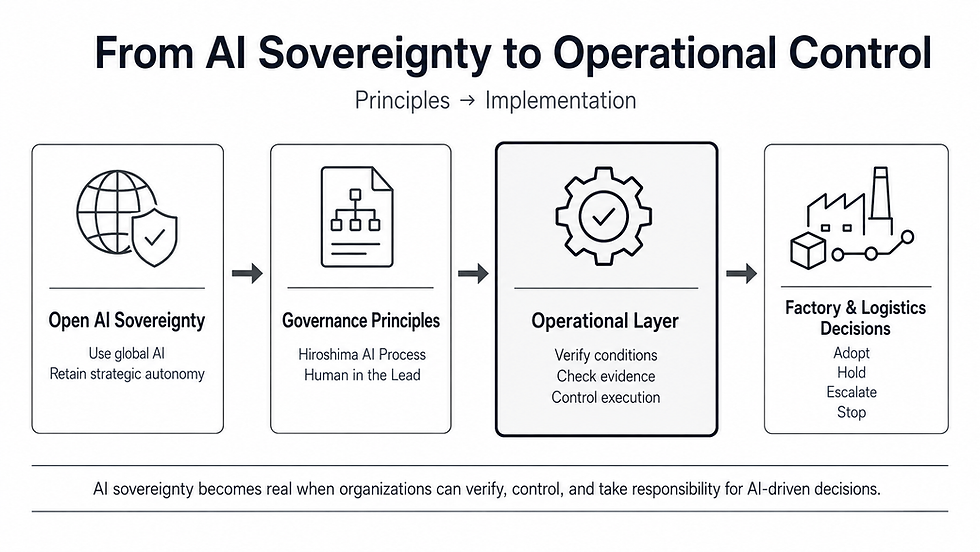
On July 14, 2026, the Government of Japan approved "Japan’s Second AI Basic Plan" by Cabinet Decision[^1]. The concept of "Open AI Sovereignty" articulated in this plan does not define AI sovereignty as full technological autarky across the AI ecosystem. Instead, it aims to establish a framework where Japan can independently select and operate trusted AI models when needed, avoiding excessive dependence on particular countries or companies, while ensuring interoperability and coordination with like-minded countries. The Japanese government defines this strategy as securing "strategic autonomy" and "strategic indispensability" across the broader AI ecosystem[^1].
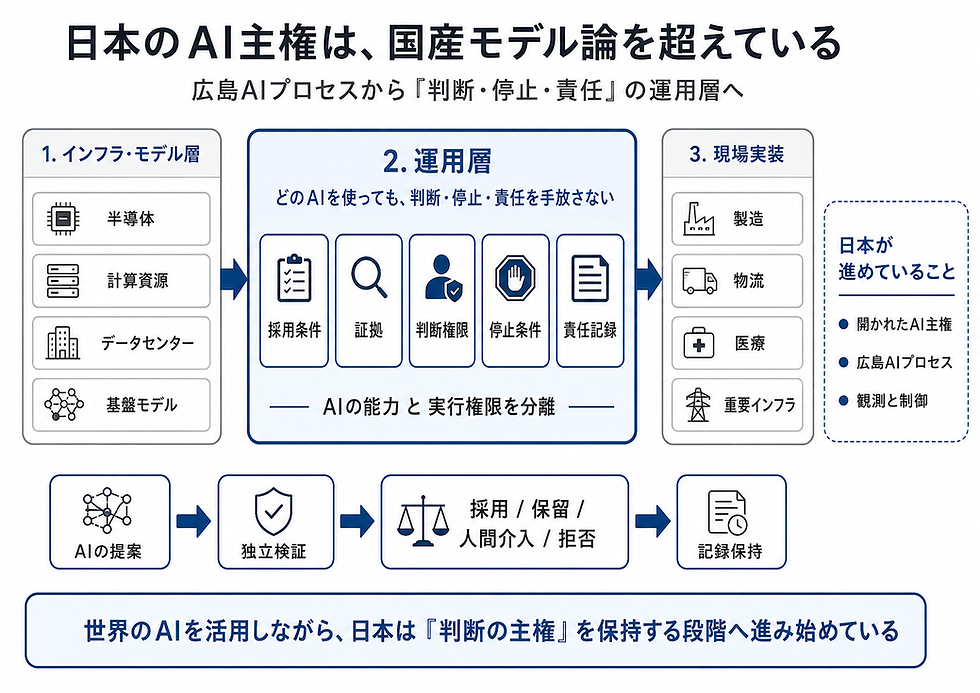
Discussions surrounding AI sovereignty often concentrate on the infrastructure and foundation model layers—such as semiconductors, computing resources, data centers, and the development of domestic frontier models. However, Japan’s AI policy and governance discourse is evolving beyond domestic model creation to address a pragmatic, operational challenge: How to safely integrate diverse AI systems into real-world applications while ensuring humans retain ultimate authority.
▼Press Release(JP)
https://prtimes.jp/main/html/rd/p/000000004.000182721.html

1. "Open Connection and Control" Over Technological Isolation
Japan’s Second AI Basic Plan does not define AI sovereignty as technological isolation. It pursues an open strategy that combines global cutting-edge AI capabilities with domestic operational readiness, technical governance, and control mechanisms[^1].
Even without developing or hosting foundation models 100% domestically, an organization can maintain operational leadership and establish safe deployment standards if the following requirements can be independently defined, verified, and monitored by the user side:
Business Logic & Rules: Functional constraints and logic required for operational compliance.
Evidentiary Basis: Verification data and logs required for auditability.
Authority Framework: Clearly assigned decision-making and approval permissions.
Control Criteria: Automated safety rules to pause or override processing.
Human Involvement in Task Execution (Human in the loop).
Human Oversight & System Architecture (Human on the loop).
Human Authority in Final Decision-Making (Human in the lead)[^1].
Ex-post Traceability: Verifiable records for retrospective auditing[^2].
The Japanese government's Guidelines on Ensuring the Appropriateness of Research, Development, and Use of AI-Related Technologies also emphasize that human operators must make final determinations regarding the scope and conditions of AI deployment, ensure post-hoc traceability, and clarify responsibility structures[^2].
2. From International Rule-Making to Operational Transparency
Japan has played a pivotal role in shaping international governance frameworks for AI. Launched under Japan’s G7 Presidency in 2023, the "Hiroshima AI Process" culminated in the Hiroshima Process International Guiding Principles[^5] and the Hiroshima Process International Code of Conduct[^6].
By March 2026, the Friends Group supporting the Hiroshima AI Process expanded to 66 countries and regions[^7]. Parallel to this state-level engagement, a Partners Community involving private enterprises and international organizations was established. Over 50 organizations have declared their submission of reports under Version 2.0 of the OECD-partnered reporting framework[^8].
This leadership in international rule-making serves as a central pillar supporting Japan’s vision of Open AI Sovereignty. Rather than ring-fencing technology within national borders, Japan seeks to establish strategic leadership by fostering global transparency, alignment, and interoperability across AI governance frameworks.
3. Evolving from Principles to "Observation and Control"
As high-level global principles solidify, the operational focus is shifting toward real-world enforcement and runtime control.
In July 2026, Japan’s AI Safety Institute (AISI) published Version 1.20 of its Evaluation Perspectives Guide for AI Safety[^3]. The revised guide adds evaluation perspectives concerning autonomous behaviour and interaction with external environments, highlighting observation and runtime control as important AI safety considerations.
From an engineering perspective, this suggests the need to separate model capability from the authority to execute actions.
4. Implementation Example: "Responsibility OS" and the Operational Layer
To bridge high-level policy guidelines with enterprise-level execution, implementations of an "operational layer" are beginning to emerge. The "Responsibility OS" framework proposed and implemented by GhostDrift Mathematical Institute, Inc. represents one such approach.
Rather than attempting to build a domestic frontier model, "Responsibility OS" serves as an independent operational layer. Regardless of which underlying AI model is used, it machine-verifies requirements—such as adoption criteria, evidence inputs, authority bounds, stop conditions, and versioned rules—and maintains audit trails for independent third-party verification.
[ AI Proposal / Generation ]
        ↓
[ Independent Verification Layer (Responsibility OS) ]
  (Validates logic, evidence, permissions, and rule versions)
        ↓
[ Decision Determination ]
  (Approve / Hold / Human Intervention / Reject)
        ↓
[ Versioned and Verifiable Record ]
  (Preserves decision rationale, authority, evidence, and rule-version history for later verification)
Real-World Validation: Pharmaceutical Cold Chain PoC
In the joint PoC conducted by GhostDrift Mathematical Institute, Inc. and ON THE LINKS Co., Ltd.[^9], handover candidates were not automatically treated as final corporate decisions. Temperature records and other evidence were checked using independent verification logic, and a candidate was determined to be eligible for handover only when the predefined conditions were satisfied. The resulting decision basis could then be re-verified retrospectively.
Rules and criteria must adapt flexibly to changing operational environments (Agile Governance[^1]).However, the evidentiary basis and logic used to make a specific past decision must remain fixed and verifiable, so that subsequent changes can be detected and the original decision basis can be re-verified.
By decoupling AI proposal capabilities from organizational execution authority, enterprises can harness global AI developments while retaining full control over decisions, overrides, and accountability.
5. Transforming Operational Quality into Strategic Indispensability
Japan's Second AI Basic Plan highlights "Vertical AI" (tailored to specific industrial and administrative domains) and "Physical AI" (operating in the physical world via machinery and robotics) as core national strengths[^1][^4].
In sectors like advanced manufacturing, logistics, healthcare, and critical infrastructure, Japanese industry has long cultivated rigorous quality management practices: strict process adherence, evidence retention, anomaly-triggered shutdowns, segregated permissions, and root-cause traceability. Translating these operational practices into machine-verifiable rules and executable software protocols offers a key opportunity to project Japanese quality engineering into global digital infrastructure.
Japan does not need to build every frontier model natively to remain vital to the global AI ecosystem. By providing the operational control layer that enables global AI to be safely and accountably deployed in critical industries, Japan can establish a distinct position of "strategic indispensability."
Conclusion: Utilizing Global AI While Preserving Human Authority
Japan’s Open AI Sovereignty is moving beyond the debate over domestic model development into the design of real-world operational architectures.
Sovereignty to Build AI (Model development capacity)
Sovereignty to Select AI (Independent procurement & choice)
Sovereignty to Validate AI Decisions (Independent logic verification)
Sovereignty to Stop AI Execution (Governance & runtime control)
Sovereignty to Audit Responsibility (Ex-post traceability)
The strategy is not a binary choice between adopting global AI or protecting national sovereignty. It is about utilizing the world's best AI capabilities while retaining sovereign control over judgment, safety overrides, and ultimate responsibility.
By developing assurance mechanisms and operational control layers, Japan could contribute to a secure, resilient, and human-centric global AI infrastructure. GhostDrift Mathematical Institute, Inc. aims to advance one such implementation through AI Assurance and Responsibility OS.
References & Primary Sources
[^1]: Cabinet Office of Japan, Strategic Headquarters for AI, Japan’s Second AI Basic Plan (Cabinet Decision, July 14, 2026). [^2]: Cabinet Office of Japan, Strategic Headquarters for AI, Guidelines on Ensuring the Appropriateness of Research, Development, and Use of AI-Related Technologies (December 19, 2025). [^3]: AI Safety Institute (AISI Japan), Evaluation Perspectives Guide for AI Safety, Version 1.20 (July 7, 2026). [^4]: Cabinet Office of Japan, Vertical AI Sectoral Strategy: Interim Report. [^5]: G7 Hiroshima AI Process, Hiroshima Process International Guiding Principles for Organizations Developing Advanced AI Systems. [^6]: G7 Hiroshima AI Process, Hiroshima Process International Code of Conduct for Organizations Developing Advanced AI Systems. [^7]: Ministry of Foreign Affairs of Japan, The Second In-Person Meeting of the Hiroshima AI Process Friends Group (March 16, 2026). [^8]: OECD, OECD launches Hiroshima AI Process Reporting Framework 2.0 (May 29, 2026). [^9]: GhostDrift Mathematical Institute, Inc., GhostDrift and ON THE LINKS Complete Phase 1 Machine Verification PoC for Pharmaceutical Cold Chain Logistics and Release Code (July 28, 2026).

コメント