
AI Assurance 2026: Where We've Arrived, Where We Fall Short, and How ADIC Changes the Game
- kanna qed
- 5月5日
- 読了時間: 6分

The regulatory frameworks are moving. Standards are taking shape. The third-party assurance market is standing up. The real question now is whether we can leave AI decisions behind as evidence that others can actually verify.
AI assurance is moving from "being managed" to "being proven." What's needed is not simply explaining AI decisions — it's leaving them as verifiable evidence that third parties can reconstruct.
Introduction: AI Assurance Has Moved from Principle to Practice
In 2026, AI assurance is no longer something organizations can treat as optional good practice.
The EU AI Act, ISO/IEC 42001 and 42006, the NIST AI RMF, and a growing third-party AI assurance market — led in policy terms by the UK — have made it a concrete operational obligation to demonstrate how AI is governed, evaluated, and assured.
Yet precisely because frameworks and audits are starting to come together, the next limitation is coming into focus: can individual AI decisions be left behind with enough structure — covering premises, conditions, rationale, and intervention history — that a third party can actually verify them after the fact?
▼About ADIC
https://www.ghostdriftresearch.com/adic
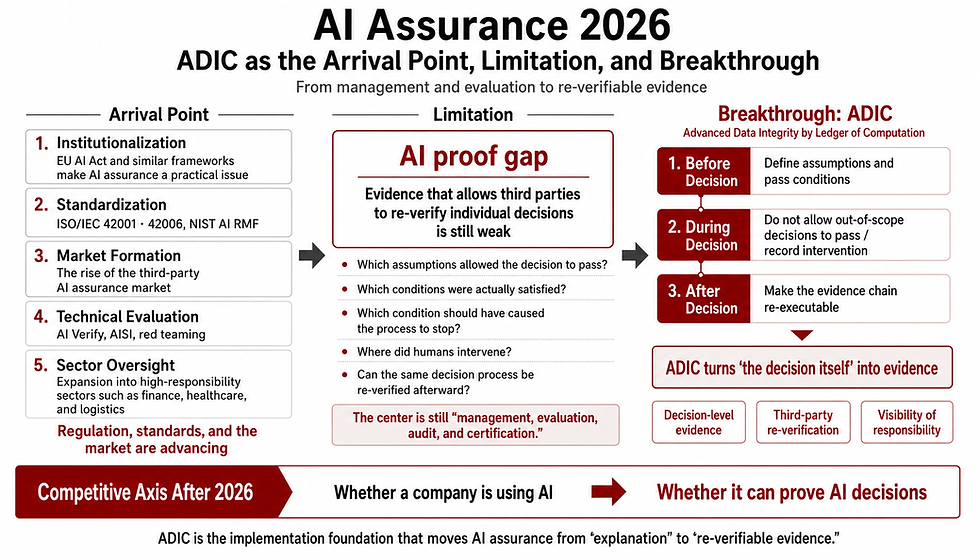
1. Where We've Arrived: The State of AI Assurance in 2026
AI assurance has advanced across five distinct domains.
Regulation: The EU AI Act
The EU AI Act enters full application on August 2, 2026. However, high-risk AI systems embedded in product safety legislation retain a transition period until August 2, 2027, and the Digital Omnibus proposals have introduced further discussion of partial delays — so specific timelines remain in flux.
What matters is that the direction is irreversible: AI risk management, transparency, technical documentation, logging, and conformity assessment have become compliance requirements. AI assurance is no longer an ethics discussion. It is a regulatory obligation.
Standardization: ISO / NIST / OECD
ISO/IEC 42001 established AI management systems as a certifiable discipline. ISO/IEC 42006:2025 went further, setting requirements for the bodies that audit and certify those systems — meaning rigor and consistency are now expected on both sides of the assurance relationship.
The NIST AI RMF provides a shared vocabulary across Govern, Map, Measure, and Manage functions, with sector-specific profiles for generative AI and critical infrastructure following. The OECD AI Principles (adopted 2019, updated 2024) anchor the international dimension. The common language of AI risk management is largely in place.
Market Formation: Third-Party AI Assurance
The UK government's 2025 Trusted Third-Party AI Assurance Roadmap signaled a clear policy commitment to building a professional market around AI assurance — covering specialist credentials, competency frameworks, and an AI Assurance Innovation Fund.
Major professional services firms, including Deloitte and the broader Big Four, have moved into AI governance and assurance services in earnest. Corporations, insurers, and regulators are increasingly seeking independent verification of AI trustworthiness. AI assurance has become a commercial services market.
Technical Evaluation: AI Verify and the AI Safety Institutes
Singapore's AI Verify Foundation and IMDA launched the Global AI Assurance Pilot in February 2025, pairing live generative AI applications with specialist testing firms to build practical know-how in technical verification, benchmarking, and red-teaming.
The UK AI Safety Institute (AISI) has made frontier model evaluation a national-level function. The International AI Safety Report 2026 documents that 12 companies published or updated Frontier AI Safety Frameworks in 2025, covering red-teaming, capability evaluation, conditional release criteria, and incident reporting. AI assurance has moved from checklists to technical testing — though as we'll see, that testing stops short of making individual decision-level evidence re-runnable.
Sector Supervision: Finance and Critical Infrastructure
High-responsibility sectors are seeing AI use itself become a supervisory matter. Australia's APRA issued a letter to the financial industry in April 2026 explicitly calling out weaknesses in AI risk management and governance at banks, insurers, and superannuation funds.
In Japan, updated annexes to the AI Business Operator Guidelines have moved from principles toward practical guidance on system operation, risk handling, red-teaming outcomes, and information-sharing between operators.
AI assurance in 2026 has made genuine progress on regulation, standards, and market infrastructure. But that progress has largely been about organizing how AI is managed, evaluated, and audited — not about the evidentiary layer underneath individual decisions.
2. Where We Fall Short: The Evidence Gap
The center of gravity in AI assurance today still rests on:
Policies, guidelines, and checklists
Technical documentation and model evaluation
Audit reports and red-teaming outputs
Certification and conformity assessments
These matter. But when something goes wrong, they struggle to answer:
On what premises did that AI decision pass?
What conditions were in place at the time?
Which conditions, if they had failed, should have stopped it?
Where did humans approve, modify, or intervene?
Can a third party reconstruct the same decision process after the fact?
The AI Proof Gap
Grant Thornton's 2026 survey found that 78% of senior executives lacked confidence that their organization could pass an independent AI governance audit within 90 days — a finding the firm characterized as an "AI proof gap" between AI investment and accountability infrastructure.
Reuters reported in April 2026, drawing on a Cambridge Centre for Alternative Finance study covering 600+ entities across 151 countries, that only 20% of financial regulators have advanced AI adoption — meaning the supervisory side is falling behind the institutions it oversees.
The International AI Safety Report 2026 makes a parallel observation: even as 12 companies formalized Frontier AI Safety Frameworks, external evaluation and standardized independent audit remain limited in scope.
How Current Approaches Compare
Assurance Approach | Governance & Evaluation | Decision-Level Evidence | Third-Party Re-verification |
ISO/IEC 42001 (AI Management System) | ✔ Strong | △ Indirect | △ Organizational level |
NIST AI RMF | ✔ Strong | △ Framework only | △ Framework only |
Red-teaming / Model evaluation | ✔ Strong | △ Model-level only | △ Pre-deployment only |
Third-party audit (Big Four, etc.) | ✔ Strong | △ Sampling-based | △ Relies on post-hoc documents |
ADIC | ✔ Complements existing governance | ✔ Evidence at decision level | ✔ Re-executable verification |
The distinction matters: existing AI assurance largely examines organizations, models, and documents. ADIC produces evidence about the decisions themselves.
The next limitation in AI assurance is not a lack of explanation. It is the absence of a verifiable evidence structure at the level of individual decisions.
3. The Emerging Competitive Axis: From "Using AI" to "Proving AI"
AI adoption itself is no longer the differentiator. The question shifting to the center is how far organizations can actually stand behind the decisions their AI makes.
In high-responsibility domains, AI decisions connect directly to:
Product liability and damages exposure
Counterparty trust and credit risk
Regulatory compliance and audit readiness
Investor, insurer, and supervisory disclosure
The risk that accountability diffuses into ambiguity after an incident
After 2026, the competitive axis in AI assurance shifts from "do you use AI" to "can you prove what your AI decided."
4. The Breakthrough: ADIC as an Evidentiary Layer
ADIC (Advanced Data Integrity by Ledger of Computation) is not a replacement for existing AI assurance frameworks. It is an evidentiary layer built on top of them — making it possible for third parties to verify, after the fact, the premises, pass conditions, stop conditions, decision rationale, and evidence chain behind individual AI decisions.
The Three Phases ADIC Covers
Before the Decision — Define the premises and pass conditions Establish upfront what conditions must hold for a decision to proceed. Structure the decision criteria themselves, eliminating ambiguity before it reaches the model.
At the Decision — Block what falls outside conditions Prevent decisions that fall outside defined conditions from passing unchallenged. Exception handling and human intervention are captured and structured automatically.
After the Decision — Make the evidence chain re-executable Leave behind a record of why a decision passed or was stopped — in a form that a third party can reconstruct under the same conditions later.
5. Application: Pharmaceutical Cold Chain Logistics
Pharmaceutical cold chain logistics is a domain where AI assurance moves from abstraction to operational accountability. Multiple parties are involved — pharmaceutical manufacturers, CMOs, 3PLs, distributors, and healthcare institutions — and decisions around temperature excursions, handoffs, exception handling, and release authorization connect directly to product liability and reputational risk.
What changes when ADIC is in place:
Pharma Manufacturer → CMO / 3PL → Distributor → Healthcare Institution → Third-Party Verification
ADIC leaves the decision evidence at each point in this chain — release/hold calls, temperature deviation assessments, handoff confirmations, exception dispositions — in a form that can be re-verified. When a temperature excursion occurs, the question of which premises were in place when the release decision passed, and which conditions had already failed, has a structured, re-auditable answer.
The same question applies in financial credit decisions, infrastructure inspection, and clinical decision support. Wherever AI is making consequential judgments, the need for re-verifiable decision evidence is the same. ↓Details(JP) https://prtimes.jp/main/html/rd/p/000000008.000169775.html
Conclusion: AI Assurance Is Moving Toward Re-verifiability
Where we've arrived: The regulatory, standards, and market infrastructure for AI assurance has made real progress — EU AI Act, ISO 42001/42006, the Big Four, AI Verify, the AI Safety Institutes, and sector-level supervision are all moving in the same direction.
Where we fall short: The center of gravity is still on governance, evaluation, audit, and certification. The layer that makes individual decision evidence re-executable by a third party remains underdeveloped.
The breakthrough: ADIC fills that gap. It moves AI assurance from explanation infrastructure to verifiable evidence infrastructure — making it possible to stand behind what AI decided, not just how AI is managed.
Explaining what an AI decided is no longer enough. The premises, conditions, and rationale on which that decision rested must be verifiable by a third party after the fact. ADIC is the implementation layer that makes that possible — advancing AI decisions from "explainable" to "re-verifiable evidence."
AI Assurance 2026 — ADIC Review


コメント