
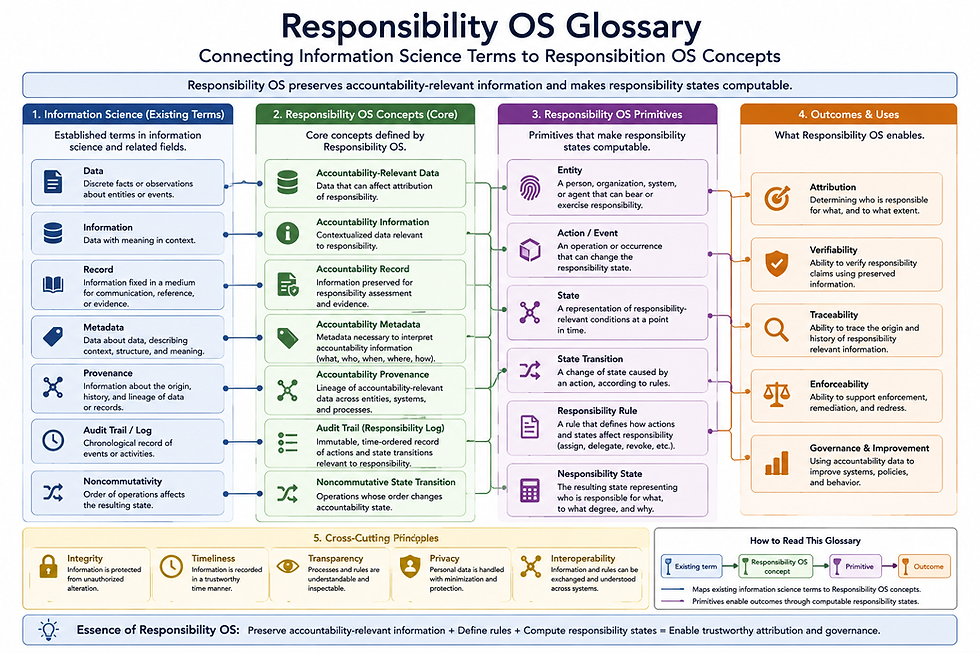
Responsibility OS Glossary — Connecting the Concept to Information Science
- kanna qed
- 6月13日
- 読了時間: 8分

Introduction
“Responsibility OS” is a proposed information infrastructure that allows the responsibility state behind a decision or action to be audited, inspected, and verified after the fact, once that decision has had an effect in the real world.
Not all of the vocabulary behind this concept is new. Information science already has closely related concepts such as provenance, traceability, audit trails, and metadata. At the same time, terms such as “Accountability-Relevant Information,” “Accountability State,” “Noncommutativity,” “Commutativization,” and “Information Loss” are terms we are introducing here, in order to re-bundle these existing concepts from the perspective of Responsibility OS.
The purpose of this glossary is to keep these two groups distinct. By making explicit which terms are existing standard vocabulary and which are redefinitions specific to Responsibility OS, readers can judge how much of the Responsibility OS argument rests on existing information science, and where the new claims begin.
Note that the mathematical core of Responsibility OS is published as a Lean 4 formal proof at [responsibility-os-kernel](https://github.com/GhostDriftTheory/responsibility-os-kernel). Where relevant, this glossary indicates how each term corresponds to that formalization. The theorem and definition names referenced below reflect the state of the repository at the time of writing, and may change in future revisions.
▼Responsibility OS https://github.com/GhostDriftTheory/responsibility-os-kernel
— -
Three Layers of Terminology
The terms relevant to Responsibility OS fall roughly into three layers.
Layer 1: Existing information-science standard terms — Provenance, Traceability, Audit Trail, Metadata, Auditability, Verifiability, State Transition. These terms have established grounding in existing literature and standards, and are used here with their standard meanings.
Layer 2: Core terms specific to Responsibility OS — Accountability-Relevant Information, Accountability State, Unverified Conditions. These are not the standard terms themselves, but terms we introduce to re-bundle the Layer 1 concepts from the single perspective of “whether responsibility can be inspected afterward.”
Layer 3: Mathematical terms specific to Responsibility OS — Noncommutativity, Commutativization, Information Loss. These describe how accountability-relevant information can be lost, and why it must not be, and connect directly to the Lean formalization.
Each term is discussed below.
— -
Layer 1: Existing Information-Science Standard Terms
Provenance
Provenance describes where information came from, and which activities and agents it passed through during its generation and transformation. In W3C PROV, provenance is formalized as a relationship among entities, activities, and agents, and agents are positioned as bearing some responsibility toward those activities and entities.
Role in Responsibility OS: provenance supports the “who, through what process” portion of accountability-relevant information. If provenance information is lost, it becomes impossible to trace the path by which a decision was generated.
Traceability
Traceability is the property of being able to trace an action or outcome back to the agent and conditions that produced it. In security and governance contexts, the ability to trace an action back to the agent responsible for it is treated as a precondition for accountability.
Role in Responsibility OS: traceability is the foundation for the property that accountability-relevant information can be “traced back and confirmed afterward.” Where provenance describes the path itself, traceability guarantees that the path can actually be followed back.
Audit Trail
An audit trail is a chronological record of who did what, and when. It is typically described as the record reconstructing the sequence of activities leading to access, operations, or a particular event within an IT system. Audit trails and traceability are commonly described together as recording who acted, when, and being able to trace that action back to its agent.
Role in Responsibility OS: an audit trail directly records the “who, when, what” portion of accountability-relevant information. What Responsibility OS is concerned with is whether this record is connected to the grounds, verification status, and scope of the decision. A record that exists in isolation is not sufficient as accountability-relevant information.
Metadata
Metadata is information about information — for example, the creation date, format, or source of a piece of data.
Role in Responsibility OS: metadata itself is a neutral concept. Rather than treating accountability-relevant information as simply a subset of metadata, Responsibility OS treats it as information that connects the metadata needed to inspect an accountability state with provenance, audit trails, grounds, verification status, and unverified conditions. Accountability-relevant information may include relevant metadata, but it is broader than metadata alone — it is defined by these connections, not by the metadata category.
Auditability
Auditability is the property that allows an external party to confirm whether a decision or process was carried out correctly. It is a widely used term across information science, security, and governance.
Role in Responsibility OS: auditability is one of the states Responsibility OS aims to support. If accountability-relevant information is properly preserved and connected, auditability follows.
Verifiability
Verifiability is the property that certificates, conditions, logs, or computational results can be confirmed to be correct against a defined set of rules.
Role in Responsibility OS: verifiability is a stronger requirement than auditability. Auditability refers to the ability to “confirm,” whereas verifiability refers to the ability to “demonstrate correctness against rules.” The Lean formalization of Responsibility OS is an attempt to underwrite this verifiability at a mathematical level.
State Transition
A state transition describes a change from one state to another — a concept widely used across information science and mathematics.
Role in Responsibility OS: accountability-relevant information is not the decision or action itself, but information attached to a state transition. An event such as “the AI approved this” is a transition from one state to another, and accountability-relevant information describes what accompanied that transition.
— -
Layer 2: Core Terms Specific to Responsibility OS
Accountability-Relevant Information
This is the core concept of Responsibility OS. It refers to the information that must not be lost, regarding real-world decisions, actions, and state transitions, in order to audit, inspect, and verify the accountability state afterward. Specifically, this includes provenance, audit trails, traceability, participants, authority, grounds, verification status, unverified conditions, order, location, scope of impact, and irreversibility.
This is not a standard term that already exists as such in information science. It is a term used to re-bundle the existing concepts from Layer 1 from the single perspective of “whether responsibility can be inspected afterward.” Provenance, traceability, audit trails, and metadata can each exist independently as concepts; accountability-relevant information refers to the state in which these are connected to the accountability state of a decision or action.
Accountability State
The accountability state refers to, at a given point in time, the overall set of facts about where responsibility lies and under what conditions for a given decision or action — who was involved, on what grounds, at what stage, and what was verified versus left unverified.
This too is not an existing standard term, but a mathematical term introduced on the Responsibility OS side. We use “Accountability State” rather than “Responsibility State,” as it is closer to the vocabulary of information science and governance. Accountability-relevant information is, in this framing, the information needed to reconstruct the accountability state afterward.
Unverified Conditions
Unverified conditions refer to conditions or premises that had not been confirmed at the time a decision was made. Rather than a literal phrase like “unchecked points,” “Unverified Conditions” — or “Unverified Assumptions” — fits better with the vocabulary of information science and assurance.
Role in Responsibility OS: even if an AI outputs “safe,” if the unverified conditions underlying that judgment are not recorded, the accountability state cannot be inspected afterward. Unverified conditions are among the parts of accountability-relevant information most prone to being lost.
— -
Layer 3: Mathematical Terms Specific to Responsibility OS
Noncommutativity
Noncommutativity is the property that swapping the order of operations changes the meaning or outcome. While this is a formal term in mathematics, it is not a standard core term in information science. Responsibility OS uses it to make the claim that accountability-relevant information is noncommutative — that swapping its order changes its meaning and the resulting accountability state.
For example, an AI making a decision first and a human reviewing it afterward is not the same as a human verifying the conditions first and the AI then making the decision — even if both produce the same “approved” output, the accountability states differ. The same applies in environmental contexts: cutting down a forest and then replanting is not the same as maintaining a forest while tending it, even if the resulting number of trees or area of green space is identical, because soil, water systems, ecosystems, and the recoverability of these over time are not the same.
Correspondence to the Lean formalization: this claim corresponds to `ResponsibilityOS.standard_trace_is_faithful` (the standard responsibility trace is faithful). Faithfulness here means that transitions that are operationally distinct remain distinguishable once recorded together with accountability-relevant information.
Commutativization
Commutativization refers to the process of reducing information that originally carries order, provenance, relationships, and irreversibility into a form such as a score, label, or output — a form that can be treated the same way regardless of order.
This term exists in mathematics but is not a standard term in information science or data management. When used as a term coined within Responsibility OS, it requires explanation on first use. In terms closer to information science, related expressions include lossy abstraction, flattening, or reduction to scores or labels.
Commutativization itself is not inherently bad — it is a necessary process for handling complex reality. The problem is when, in the course of commutativization, the information needed to inspect accountability is also discarded.
Correspondence to the Lean formalization: the way commutativization can damage accountability-relevant information is formalized in `ResponsibilityOS.forgetting_responsibility_layer_can_collapse_distinctions` (a forgetful operational view can identify distinct responsibility traces). The `CollapseCounterexample.tracePolicy` is a concrete example showing two traces (`traceA` and `traceB`) that appear identical from an operational perspective, but should be distinguished from an accountability perspective.
Information Loss
In Responsibility OS, information loss does not refer to simple compression failure, or to a general reduction in the amount of information. It refers to a situation in which accountability states that should be distinguishable come to look like the same output or the same score.
Even if an AI outputs “safe,” if the grounds for that judgment, the conditions that were left unverified, and the point-in-time data it was based on are lost, the accountability state cannot be inspected afterward. What Responsibility OS aims to prevent is not a reduction in the quantity of information per se, but the loss of the information needed to distinguish between accountability states.
Correspondence to the Lean formalization: `ResponsibilityOS.PreservesPolicy` defines whether a visible operational view preserves a given set of accountability/evidence distinctions that should be observable (`ObservationPolicy`). Information loss corresponds to a failure of this preservation — that is, to a situation in which accountability states that should be distinguished under a given policy become indistinguishable in the visible operational view.
— -
On Real-World Information
“Real-world information” is used in the definition of Responsibility OS to refer to information that is not self-contained within a computer system. This includes information related to the state and changes of the natural environment, social institutions, organizations, land, water, resources, climate, human actions, and AI decisions.
This term itself is not new — it is actually used in fields such as real-world computing, IoT, cyber-physical systems (CPS), and digital twins. Within Responsibility OS, however, this term is not treated as a core concept. Instead, the definition is framed around accountability-relevant information as the subject: accountability-relevant information is the subset of real-world information that must not be lost in order to confirm the accountability state afterward.
— -
Summary: The Definition of Responsibility OS
With these terms in place, Responsibility OS can be defined as follows.
> Responsibility OS is an information infrastructure that preserves and connects the accountability-relevant information contained within real-world information, prevents the information loss that results from excessive commutativization into scores, labels, and outputs, and supports auditability, inspectability, and verifiability after the fact.
In this definition, provenance, traceability, audit trails, metadata, auditability, verifiability, and state transition are existing standard terms in information science; accountability-relevant information, accountability state, and unverified conditions are core terms specific to Responsibility OS; and noncommutativity, commutativization, and information loss are mathematical terms specific to Responsibility OS. This three-layer structure is intended to let readers distinguish how much of the Responsibility OS argument extends existing information science, and where the new proposals begin.
For the mathematical underpinnings, see the [Responsibility OS Kernel (Lean 4 formal proof)](https://github.com/GhostDriftTheory/responsibility-os-kernel).


コメント