
Why MPC “Adjustability” is Fatal in Audits: Weights, Slack, and Model Updates
- kanna qed
- 1月11日
- 読了時間: 4分

Model Predictive Control (MPC), characterized by its real-time execution of constrained optimization, represents the contemporary zenith of control for complex energy systems. Its capacity to consolidate multiple objectives into a single cost function while anticipating future states is a masterpiece of modern engineering.
However, this very “flexible optimality” becomes a critical liability when social accountability is demanded — such as during forensic audits or accident investigations. Regardless of a calculation’s sophistication, if the underlying parameters are adjustable after the fact, the system’s accountability effectively evaporates.
This article explores how the ADIC (Accountable Deterministic Information Closure) approach seals the operational loopholes inherent in MPC without compromising its performance, providing the evidentiary integrity required for rigorous audit and incident response.
▼ADIC Demo

1. The Technical Preeminence and Engineering Pride of MPC
In industrial practice, MPC is favored not merely for its tracking precision, but for an architecture that explicitly embeds physical constraints and multi-objective optimization into its core logic.
The Rationality of Receding Horizon: By re-solving optimization problems for a horizon $N$ at each sampling interval $k$, MPC provides a robust framework for absorbing uncertainties — an essential trait for energy environments subject to volatile disturbances.
The Sophistication of Multi-Objective Integration: Balancing battery State of Charge (SoC) health, degradation mitigation, and market price tracking is a complex task. The consolidation of these variables into a single cost function $J$ via weight matrices $Q$ and $R$ is where a designer’s true expertise is manifested.
Strict Constraint Management: Whether managing renewable curtailment or grid stability, MPC serves as the “intelligent core” of autonomous systems, deriving solutions while providing mathematical guarantees for non-negotiable operational boundaries.
2. The “Evaporation of Responsibility”: The Hidden Cost of Arbitrary Adjustability
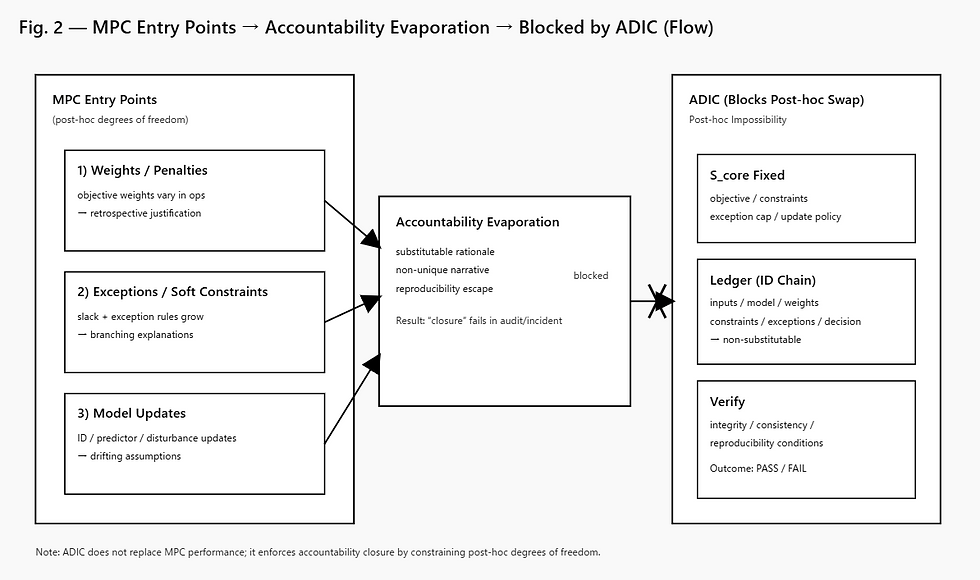
The more versatile an MPC system becomes, the more difficult it is to substantiate the “basis of decision-making” during an audit. Since optimization outcomes depend entirely on the specific parameters adopted, and those parameters are often dynamic, the system lacks a fixed point of accountability.
2.1 Identifying “Post-hoc Possibilities” in Field Operations
In practical MPC deployment, three primary “interpretative degrees of freedom” undermine accountability:
Fluidity of Priorities via Weights $Q$ and $R$: Weights are frequently tuned to adapt to shifting priorities. However, the ability to claim retrospectively that “safety was the priority at the moment of the incident” to justify a specific outcome creates a systemic vulnerability that traditional audits cannot resolve.
Normalization of Exceptions via Soft Constraints (Slack Variables): Using soft constraints to prevent solver “infeasibility” is a practical necessity. Yet, if the thresholds for these relaxations remain ambiguous or adjustable, they allow for arbitrary post-hoc justifications of boundary violations.
Opacity of Model Updates and Predictors: With the rise of online identification and AI-driven predictors, proving exactly which version of a model produced a specific command — and on what evidential basis — is nearly impossible within current architectural frameworks.
3. The Limits of Conventional Approaches: Logs and Simulations
3.1 Logs Record “What” but Cannot Fix “Why”
Traditional time-series logs capture data points but not the underlying “intent” of a dynamic optimization. Under conditions where parameters are fluid, logs remain open to multiple, conflicting interpretations after the fact.
3.2 Digital Twins provide “Reconstruction” but not “Closure”
Simulations can reconstruct an event, but they cannot prove that a specific decision was the only valid one under the rules established at the time. Accountability requires closing the “branching paths” of possible explanations.
4. Proposing the Frontier: Beyond Explainability to “Post-hoc Impossibility”
The industry must move beyond “Explainability” — a term often reduced to subjective plausibility — toward a more rigorous standard.
Definition: Post-hoc Impossibility Even if an MPC solution is mathematically optimal, social accountability is not established if the premises of that calculation (weights, constraints, models) can be substituted after the fact. Accountability requires that the “basis for the decision is structurally closed at the moment of execution, ensuring that any post-hoc substitution is detectable through verification.”
5. Mathematical Sealing via ADIC: Integrity Without Algorithmic Sacrifice
ADIC (Accountable Deterministic Information Closure) functions as a mathematical “seal” around existing MPC processes, providing structural integrity without modifying the internal optimization logic.
S_core (Structural Fixation): Before deployment, the cost function structure, constraint thresholds, and update policies are registered as immutable IDs. This ensures that operations remain valid only under pre-defined, authorized rules.
Ledger (Evidentiary Chain): At each step, inputs, model IDs, weight IDs, and outcomes are linked using a “tamper-evident chain structure.” Any attempt to alter the parameters after the fact results in a mismatch within the chain, ensuring that substitution is detected through verification.
Interval Constraining (Outer Rounding): Floating-point discrepancies are eliminated as a source of interpretative ambiguity. By constraining judgment criteria within specific intervals, ADIC ensures the consistency of verification, where results are managed within a range where discrepancies are strictly prohibited.
6. Case Study: Closing the Accountability Gap in Battery MPC
6.1 Scenario: The Conflict Between Grid Response and SoC Maintenance
Consider a battery system that fails to respond to a grid frequency deviation because its MPC prioritized SoC maintenance to prevent cell degradation.
Conventional MPC: Post-incident, engineers may argue that the “SoC constraint was dominant.” However, there is no objective method to prove this wasn’t an “after-the-fact adjustment” to cover a system failure.
ADIC-Augmented MPC: The “Control Policy ID” active at the moment of the incident is indelibly recorded in the Ledger. If the pre-agreed rules permitted prioritizing SoC in that specific context, the behavior is immediately validated and exonerated as an “agreed-upon operational risk.”
7. Conclusion: Elevating Control Engineering to an Accountable Social Technology
The current frontier of MPC is no longer just performance; it is the resolution of the structural flaw where optimization premises remain “post-hoc adjustable.”
ADIC does not replace MPC; it empowers it. By equipping the “strongest spear” of control engineering with a “shield of accountability,” ADIC transforms MPC into a truly mature technology capable of sustaining the trust of a modern, regulated society.


コメント