
Why AI Governance, AI Ethics, AI Safety, Accountability, Responsible AI, and Trustworthy AI All Fail at the Same Point
- kanna qed
- 1月30日
- 読了時間: 7分

-- The "Responsibility Vacuum": The Single Unresolved Problem
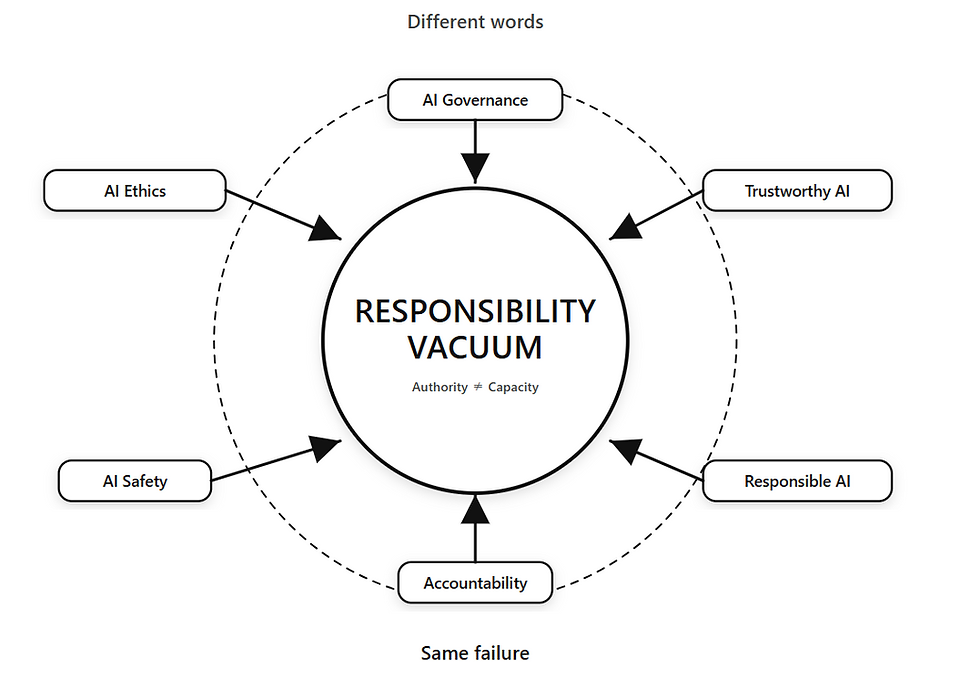
0. Introduction: The "Same Failure" Disguised in Different Terms
AI Governance, AI Ethics, AI Safety, Accountability, Responsible AI, and Trustworthy AI.
Typically, these are treated as distinct domains. Distinct experts discuss them at separate conferences, employing isolated vocabularies.
However, the assertion of this article is unequivocal: They all fracture at the exact same point.
That point is the specific failure mode where: "Decisions are executed, yet no entity exists that both understands and assumes responsibility for them."
Based on recent research (Romanchuk & Bondar, 2026), this article defines this condition as the "Responsibility Vacuum."
In the context of AI Governance, this manifests as a loss of control or an absence of accountability. In AI Ethics, it appears as the absence of a moral agent. In AI Safety, it emerges as the formalization of safety checks devoid of substance.
Yet, these are not separate issues. They all stem from the same structural inevitability: the "Separation of Authority and Capacity."
Over the past few years, companies have formulated guidelines, implemented Human-in-the-loop approval flows, and invested in Explainable AI (XAI). Despite stricter rules and comprehensive monitoring tools, the on-the-ground sense of "loss of control" has intensified, and inexplicable behaviors or unintended deployments continue to occur.
Most alarming are the cases where post-incident audits reveal that "no rules were broken."
The CI/CD pipeline operated correctly, tests passed, the approver authorized the deployment, and logs recorded the action. There was no defect in the process itself. Yet, no one can take substantive responsibility for the outcome. This is not human error or management failure; it is a structural consequence.
For an implementation approach to dealing with the impossibility defined in this article, please refer to the following discussion on "Responsibility Engineering":
How to navigate the Responsibility Vacuum: What is Responsibility Engineering? (Overview)
論文情報 Title: The Responsibility Vacuum: Organizational Failure in Scaled Agent Systems Authors: Oleg Romanchuk, Roman Bondar Source: arXiv:2601.15059 (2026-01-21)
1. The "Illusion" Premised by Current Discourse
Currently, every approach mentioned above relies on a single "tacit premise":
"If we provide appropriate information and keep humans in the loop, humans can retain final judgment and responsibility."
In other words: AI proposes, humans verify. It is believed that as long as this structure is maintained, governance, ethics, and safety will function.
However, this premise has already collapsed. Worse, what if the very "automated verification" and "safety measures" we introduce with good intentions are actually accelerating this collapse?
2. Why This is the "Greatest Challenge" -- Defining the Logical Precedence
Before proceeding, let us define why the "Responsibility Vacuum" is the greatest challenge across all these domains.
In this article, the "greatest challenge" refers to a "meta-failure condition" where failure persists even if all other principles (ethics, safety, transparency, explainability, fairness) are fully satisfied.
The Responsibility Vacuum is exactly that. Research defines this as "a state where a decision is executed, yet no subject exists that simultaneously satisfies both Authority and Verification Capacity."
Unless a subject exists where Authority and Capacity coincide, ethical judgment, safety confirmation, and the interpretation of explanations cannot be established as a final "acceptance." Therefore, the Responsibility Vacuum is not a parallel issue to ethics or safety, but the precondition for their existence. As long as this foundation is fractured, no matter what is built upon it, governance cannot be established.
3. What is the "Responsibility Vacuum"?
So, what specifically is the "Responsibility Vacuum"? This is not a metaphor. It is a precise state definition within decision-making systems.
For responsibility to be established, two elements must exist simultaneously within a single subject:
Authority: The formal right to make the decision and authorize execution.
Capacity: The cognitive capability to substantively understand and verify the content, basis, and risks of that decision.
In traditional, low-velocity development environments, these two coincided. The person who wrote the code, or the person reviewing it, possessed both Authority and the "Capacity to understand the content."
However, in environments where code generation and autonomous decision-making by AI agents have scaled, this coupling dissolves.
Humans still retain the "Authority to approve" (it is a human who presses the final button).
However, humans no longer possess the "Capacity to verify" (generation speed and complexity exceed human cognitive limits).
The decision is executed, and the approval stamp is pressed. However, the subject who understood and accepted the decision structurally ceases to exist. This is the "Responsibility Vacuum."
Crucially, this does not happen due to negligence or a lack of morals. Rather, the more the process is optimized, the more likely the vacuum is to occur.
4. Why It Inevitably Occurs at Scale (Structural Inevitability)
Why does this dissociation occur? The reason is simple and fundamentally physical.
Generation Speed ($G$): Generation by AI/agents scales infinitely with additional computational resources.
Verification Speed ($H$): Human cognitive ability and available time are biologically fixed and do not scale.
When the throughput of generation significantly exceeds the throughput of meaningful human verification, review undergoes a qualitative shift rather than a quantitative degradation. It becomes physically impossible for humans to verify every decision in detail.
Here, many organizations attempt to counter this by introducing "automated tests via CI (Continuous Integration)" or "static analysis tools." The most ironic fact pointed out by Romanchuk et al. lies here:
"The more automated verification tools you add, the faster the Responsibility Vacuum accelerates."
Why? Automated tools provide humans with a proxy signal that says "Passed (Green)." Under time constraints, humans stop reviewing the complex "code content (primary information)" and start authorizing based on the simple "CI green light (proxy signal)."
This is known as "Ritual Review."
Automation dramatically increases the "volume of judgments" but does not increase the "total volume of responsibility humans can assume" by a single degree. As a result, as automation progresses, approvals without substantive verification increase, and the zone of the Responsibility Vacuum expands.
5. Why Ethics, Safety, and Accountability Cannot Solve It
Understanding this structural problem reveals how off-target existing discussions on "AI Ethics" and "Safety" are.
Limit of "AI Ethics": Ethics demands "good judgment," but in a vacuum state, there is no "subject making the judgment" in the first place. How can a human who does not understand the content make an ethical judgment?
Limit of "Safety": Even if you attempt to build a "safe system," if the human capacity to finally confirm that safety is overwhelmed, it remains merely a "system displayed as safe."
Limit of "Accountability": Even if XAI (Explainable AI) produces a detailed report, if humans are left with no time to read it, accountability is not fulfilled. Logs remain, but they are like unread bibles.
Limit of "Trustworthy AI": Trust is a concept that is only established when a subject exists who can take responsibility when something goes wrong. Using the word "Trust" for a system with no responsible subject is a definitional error.
6. What Happens If We Ignore the "Responsibility Vacuum"?
What happens if we expand the scale of AI deployment while ignoring this problem? There is no need to predict the future. What is already happening will simply become the norm.
Bloating of Formal Audits: Because the substantive content cannot be verified, only checklists and approval flows increase infinitely. Enormous costs are incurred to stage the "appearance of compliance."
Post-Incident Blame Shifting: When an accident occurs, developers claim "it passed the tools," approvers claim "CI was green," and vendors claim "it was Human-in-the-loop." A state is achieved where everyone is correct, yet everyone is irresponsible.
Hollowing out of Governance (Ghost Drift): Below, for convenience, we use the term Ghost Drift as a descriptive label for this phenomenon where "the divergence between system behavior and organizational intent expands unnoticed" (this does not constitute a proposal of a new theory or method). Organizations believe they are in control, but in reality, the domain under no one's control expands.
7. Is There a Solution? -- Not "Improvement," but "Changing Premises"
The "Responsibility Vacuum" cannot be solved by on-site efforts or tool improvements. This is because it is a structural problem. The solution is strictly a painful "change of premises." Based on the discussion by Romanchuk et al., at least the following directions appear as points of contention (this is not an exhaustive list, nor does it provide specific design specifications).
Option A: Abandon Scaling (Throughput Constraint)
Intentionally throttle the AI generation speed ($G$) to the speed humans can "truly understand and approve ($H$)." -> Safety and individual responsibility are secured, but many benefits such as productivity improvement and competitiveness provided by AI are forfeited.
Option B: Change the Unit of Responsibility (Aggregate Level Responsibility)
Abandon the illusion that humans take responsibility for "individual code changes or decisions." Instead, shift to a form of taking responsibility for "system design philosophy" or "statistical behavior (batch unit)." -> This model tolerates individual errors and focuses responsibility on overall trends. It implies a complete departure from traditional quality control (Zero Defect philosophy).
Option C: The Standpoint of Accepted Autonomy (Conceptual Classification)
This refers to a conceptual standpoint that abandons the framework of "fixing responsibility through individual approval" and accepts the attribution of results on the organizational side (this does not propose specific institutional or implementation details). -> Specifics regarding contracts, insurance, and operational designs are outside the scope of this discussion; here, it remains a presentation of classification.
8. Conclusion: Redefining the AI Discourse
We must admit it. The myth that "humans check everything" is over.
The central challenge of AI Governance, AI Ethics, AI Safety, Accountability, Responsible AI, and Trustworthy AI is no longer the moral question of "how to use AI for good." It is a cold, calculated question of design: "Where do we fix the locus of responsibility in advance in the domain where Authority and Capacity diverge (the Responsibility Vacuum)?"
Discussions on "Responsible AI" that do not face this vacuum end as empty slogans. Because in the current paradigm, the system is designed so that the more correctly it operates, the more responsibility vanishes.
The Responsibility Vacuum arises not from a lack of norms but from the structure of the "separation of Authority and Capacity." Thus, it is not a problem of optimization, but of boundary design.
Based on structure analysis of "The Responsibility Vacuum: Organizational Failure in Scaled Agent Systems" (Romanchuk & Bondar, 2026).


コメント