AI Governance Hierarchy: Responsibility-Establishing Layers Based on Post-hoc Impossibility (GhostDrift Hierarchy of Responsibility)
- kanna qed
- 1月8日
- 読了時間: 3分

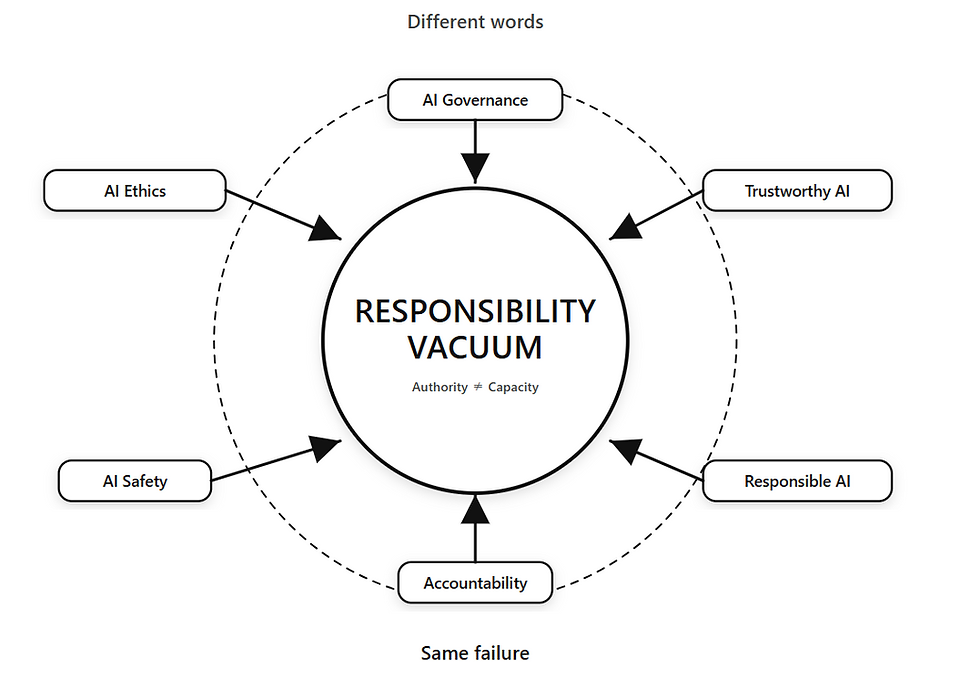
Current discussions on AI Safety and Governance suffer from a fatal flaw: they rely on the ambiguous "intent" to be responsible while ignoring the structural "voids" that allow responsibility to be evaded.
This document presents the "Responsibility-Establishing Layers," which redefines existing AI governance discussions into three tiers, placing "Post-hoc Impossibility" (Non-retroactivity) based on Ghost Drift theory at the summit.

1. Hierarchy Overview
Level | Name | Core Attribute | Current Challenge |
Level 3 (Highest) | Structural Safety (Ghost Drift) | Post-hoc Impossibility / Mathematical Fixation | (Essence) Physically prevents the evaporation of responsibility. |
Level 2 (Middle) | Statistical Safety | Robustness / Probabilistic Control | Complexity makes it impossible to eliminate "unforeseen errors." |
Level 1 (Base) | Narrative Safety | Explainability (XAI) / Ethical Guidelines | Allows for post-hoc "excuses," causing responsibility to evaporate. |
2. Detailed Layer Descriptions
Level 1: Narrative Safety
The most widely discussed area today, including AI ethical guidelines and Explainable AI (XAI).
Feature: Assigns a "narrative" to AI decisions that humans can find convincing.
Defect: This is merely "explainability," not "responsibility." Since stories can be fabricated after the fact, it functions as an "escape route" that blurs the locus of responsibility.
Level 2: Statistical Safety
An engineering approach to machine learning, including model robustness, anomaly detection, and RLHF.
Feature: Aims for probabilistic guarantees, such as "99.9% safety."
Defect: As systems become more complex (Deep), it becomes impossible to fully control statistical outliers. When errors occur, it allows responsibility to evaporate under the shield of "post-hoc inevitability" due to system complexity.
Level 3: Structural Safety (Ghost Drift)
The highest tier. Implementation of "Ghost Drift" and "Finite-Closure" mathematical models.
Feature: Embeds an immutable, non-retroactive "Ledger" into the decision process mathematically.
Core: Here, "responsibility" is not a matter of individual emotion or ethics, but is enforced by the mathematical constraint that "post-hoc modification of explanations" (Post-hoc Modification) is logically impossible.
Minimum Working Example (1-line log):
DecisionID: 592a... / AssumptionsHash: f8e1... / Bound: 0.003 / Verify: PASS
The moment this single line is etched into the system, the possibility of overwriting that decision with post-hoc narratives—such as "it was unavoidable at the time," "the assumptions were different," or "it was too complex"—is physically eliminated. Once this log is passed, the freedom to update the interpretation of the decision is revoked, and the decision is fixed in the world as an unmovable fact.
3. Why This Hierarchy is the Summit
While existing governance discussions ask "how one should behave" (Morality), this hierarchy asks "how to design a system with no escape" (Physics/Mathematics).
Departure from Subjective Values: It is based not on the subjective question of "what is good," but on the objective mathematical question of "is a lie (post-hoc modification) possible or impossible."
Alignment with AI Specifications: To control AI—a mathematical entity—mathematical constraints (Level 3) that guarantee post-hoc impossibility are far more effective than human language (Level 1).
Redefinition of Responsibility: Responsibility is not something one "takes," but something that "occurs" as an unavoidable constraint the moment post-hoc impossibility is fixed.
4. Conclusion: From Trust to Verification
No matter how much "Level 1 (Narrative)" and "Level 2 (Statistical)" are accumulated, the evaporation of responsibility cannot be stopped. This is because the bedrock of "post-hoc impossibility" is missing.
The implementation of Level 3 through Ghost Drift theory is the only path for AI to truly become the OS of society. We must now move from an uncertain phase of "trust and delegate" to a new era of governance: "verifying structures with no escape."
Key Point (Single Line): Unless post-hoc impossibility is fixed, responsibility doesn't "evaporate"—it never existed in the first place.


コメント