
The Intersection of Humanities and Mathematics: Grounding Dignity as a Structure through GhostDrift Mathematical Philosophy
- kanna qed
- 2025年12月25日
- 読了時間: 5分

GhostDrift does not merely aim to advocate for the humanities. We provide an "Operational Shield" for the front lines where "Dignity, Culture, and History" are at risk of being crushed by the violence of "Utility."
This shield simultaneously achieves three core effects: (a) extracting the discourse of value from the realm of "competitive comparison," (b) obstructing the evasion of responsibility through retroactive criteria-shifting, and (c) redirecting the burden of proof back onto those who seek to discard. This is not mere ideology; it is the fundamental design of structure.
Ending the "Structural Defeat" of the Disenfranchised and Transforming Emotion into a "Logical Shield"
We possess a clear and singular will: To present a structure that refuses to "discard" individuals, culture, and history, centered on the mathematical philosophy of "Finite Respect."
Historically, themes such as culture, history, and individual dignity have been systematically disadvantaged—dismissed as "unverifiable impressions" within a society that prioritizes efficiency above all else. GhostDrift changes this paradigm. We cast aside the fragile shield of emotional appeal and equip the front lines of the humanities with the robust weapon of mathematics to construct an immutable protective structure.
1. A Countermeasure to the Violence of "Utility"
Modern society is dominated by a trend that evaluates all existence through the narrow lens of "Is it useful?", "Is it efficient?", or "Is it immediately monetizable?"—effectively dismissing the study of culture and history as "wasteful."
Yet, what is the true essence of culture and history? They are the vital records of human existence: "How we have lived," "What we have cherished," and "Where we have erred and where we have stood our ground." They are the crystalline accumulation of human finitude itself.
Against the structures that trivialize these records, we push back—not with mere opinions, but with Mathematical Philosophy.
Mathematical Proposition (Operational Protocol): The Finite Respect Principle
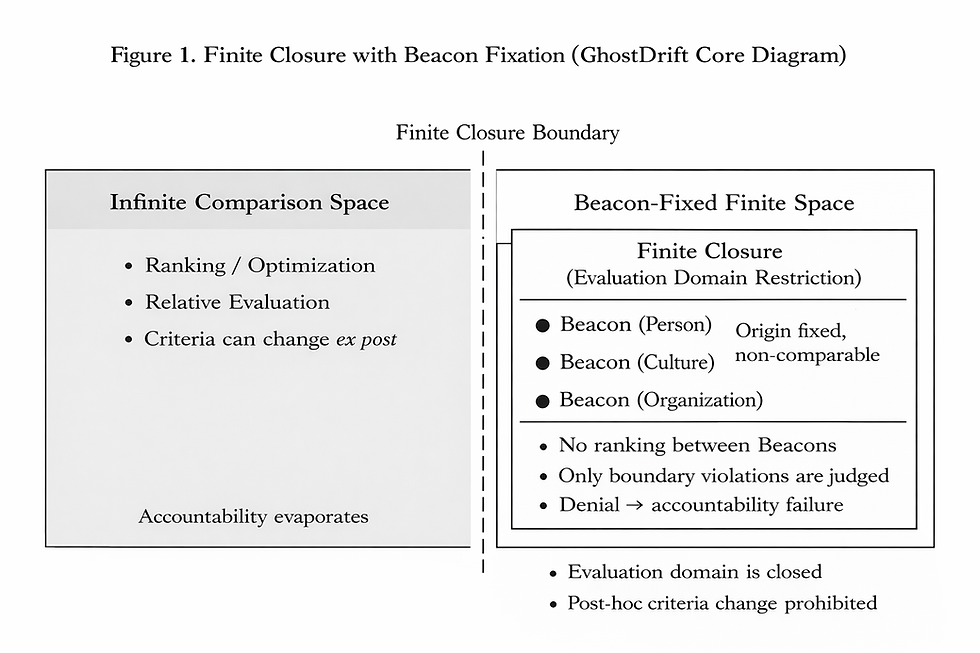
The "ranking" and "optimization" frameworks favored by contemporary society are mathematically predicated on "Infinite Comparison." Under such a structure, the value of any finite subject inevitably becomes unstable, eventually converging toward zero. We propose the operation of "Finite Closure" upon the domain of the evaluation function. Within this framework, a class defined as "Unoptimizable but Retainable" necessarily emerges. In short: mathematics proves the existence of "Values that cannot be optimized, yet must never be discarded."
Implementing Finite Respect as a "System"
Finite Closure is not an abstract concept; it is realized through operational implementation. Its minimal form consists of:
Record: Formally define "what must be protected" in concise terms and secure it with a cryptographic timestamp.
Boundary: Define any operation that compromises the protected subject (discarding, replacement, or retroactive alteration of criteria) as a "Prohibited Zone."
Judgment: The moment a party advocates for discarding the subject, the system returns a PASS/FAIL based on whether that claim has breached the pre-defined boundary.
Crucially, the central question is not the "subjective value of the object," but "whether the discarding party has violated the boundary." The more we debate value, the more the humanities lose. Therefore, we secure victory through structural design.
2. Defining an Origin Independent of Comparison: The Beacon Principle
"That’s just your opinion, isn't it?" As epitomized by this dismissal, discussions of value and dignity have historically failed because they lacked a "form of evidence." GhostDrift transforms individual dignity from a target of "evaluation" into a mathematical "Coordinate."
The Beacon Principle
By establishing a reference point (origin) for each subject that remains independent of external comparison, evaluation shifts from "Relativization" to "Coordination." A subject possessing this reference point—a Beacon—may have its distance (relationship) to others defined, but its superiority or inferiority (ordinal ranking) cannot be defined. A Beacon represents the origin of "from where that individual views the world." Humans are not beings to be ranked "above or below" one another; they are the origins from which the world is described. We formalize this human-centric view through mathematical certainty.
Implementation Patterns for Beacons
A Beacon is a unit of design, not a metaphor. It is implemented at three distinct levels:
Individual Beacon: Formalizes an individual’s non-negotiable thresholds (e.g., preservation of dignity, protection from exploitation) as "Prohibited Acts."
Cultural Beacon: Encapsulates what a work, record, or tradition "carries forward" into a concise statement, establishing a boundary against unauthorized alteration or replacement.
Organizational Beacon: Secures the reference points for decision-making (purpose, prohibited items, accountability, and scope), preventing the evasion of responsibility through post-hoc criteria-shifting.
This allows "Dignity," "Culture," and "Decision-making" to be governed by the same rigorous model. This is why GhostDrift transcends "mere philosophy" to become a functional technology.
3. "Negation" as a Form of Structural Evasion
We treat the act of negating others, discarding diversity or vulnerability, and prioritizing efficiency as the sole "justice" not as an ethical failing, but as a mathematical error.
The Beacon Non-Inferiority & Irresponsible Evasion Theorem
Parties who claim that a subject holding a Beacon is "inferior" are, in fact, implicitly exploiting the mathematical "undefined domain" to escape into a world of infinite comparison. In other words, claiming that someone’s value is low is a structural act of evasion that abandons the responsibility of defining one's own criteria. In the presence of a Beacon, it is the negating party who is revealed to be in a state of "logical collapse." Discarding is not a valid opinion; it is a failure of structural responsibility.
4. A Structure to Prevent Hardship from becoming "Withdrawn Words"
GhostDrift aims to formalize "which structures discard people and which structures protect them."
For those made to feel that their dedication is "useless."
For those carrying the weight of "invisible hardships"—the isolation of caregiving, the fear of solitary death, or systemic marginalization.
When individuals maintain their own "Beacon" (origin) while facing the world, they no longer need to feel inferior to values dictated by titles, capital, or influence. We demonstrate this not as "empty rhetoric," but as an "Unbreakable Structure" that prevents their reality from becoming "words that are withdrawn or dismissed later."
5. Three Cases: Isomorphic Structures in Dignity, Culture, and AI
Case A: Welfare and Social Support (Dignity)
"Ineligible," "Self-responsibility," "Current standards"—the moment these terms are invoked to justify abandonment, the issue is not "correctness" but the use of criteria as an escape route. Finite Closure prioritizes the "fixing of criteria and accountability," making retroactive evasion impossible.
Case B: Cultural Heritage (Culture)
"Discard it because it's obsolete," "Replace it for efficiency"—these decisions are justified through the language of optimization. By establishing a Beacon, the "reason for preservation" is fixed as a coordinate, shifting the debate from "preference" to the "observance of structural boundaries."
Case C: AI Governance and Operations (Organization)
If evaluation criteria shift retroactively, explainability and accountability collapse. GhostDrift’s stance is definitive: prohibit the "post-hoc addition of criteria." The defeats that historically plagued the humanities (being dismissed as "mere impressions") are now occurring within AI systems. We arrest this collapse using the same mathematical structure.
GhostDrift Deliverables (Operational Components, Not Ideologies)
Respect Protocol: A template to fix "What to protect," "What to prohibit," and "Who is responsible" on a single page.
Beacon Spec: A technical specification for defining Individual, Cultural, or Organizational Beacons in concise, actionable statements.
Boundary Audit: An audit format that returns PASS/FAIL on whether an advocate for discarding has breached the structural boundary.
Time-Stamped Record: A minimal data set designed to block retroactive evasion and ensure "evidence of origin."
These are not "beautiful ideals"; they are "Working Parts" engineered for immediate implementation.
Minimal Implementation
The procedure to move Dignity, Culture, and History out of the realm of "Impressions" and into the realm of "Structure" is as follows:
Define the Beacon in a single, definitive sentence.
Define exactly three Boundaries (Prohibited Acts).
Secure those three with a timestamp and prohibit any retroactive alteration.
Through this process, the act of discarding is exposed not as an "opinion," but as a "structure of abandoned responsibility." Against structures that trivialize existence, we quietly place another structure. We re-embrace history and culture as "heavy, significant things." At this intersection where the humanities meet mathematics, we continue to translate ideology into "reproducible forms" and mathematically guarantee the location of the light.
GhostDrift Research Institute for Mathematical Sciences


コメント