
Stopping “Infinite Escape” | GhostDrift’s Finite-Closure Consistency OS (Finite Closure / ADIC) and 24 Patent Filings in Verifiable Computation & Auditability
- kanna qed
- 2025年12月12日
- 読了時間: 6分

更新日:2025年12月14日
Intro: Detecting Infinite Escape and Closing It Finite — A Consistency OS/ADIC for Verifiable Computation and the Patent Portfolio Overview
At the root of the GhostDrift Mathematical Institute (GMI), there is always the same persistent question:
In mathematics, AI, energy, or law— Whenever inconvenient parts arise, we tend to resort to the same excuses:
"If we increase the sample size to infinity, it will converge."
"In the long run, it will average out."
"Edge cases can be statistically ignored."
This may look like a scientific attitude. But from the perspective of GhostDrift, there is a common structure underlying all of these statements:
GhostDrift Theory is an Operating System (basic structure) designed to stop this "escape to infinity" and maintain complete consistency within the finite world.
Today, we have released 24 patents and demos that embody this philosophy. At the core of this implementation lie the following 8 Founding Principles.

1. Finite Respect Principle
— Do not look away from the finite conditions of "Here and Now"
Everything starts here. In the real world, "infinity" does not exist.
Computing resources
Energy
Money
And our time
All of these are finite. Despite this, theoretical models nonchalantly claim:
"As n→∞, this error vanishes."
"With a sufficiently large sample, this fluctuation is negligible."
GhostDrift sees a significant "structural lie" here.
The Finite Respect Principle declares:
Do not push problems into the infinite limit.
Do not deceive with "makeshift expected values."
Handle errors and exceptions completely, while remaining finite.
The entire GhostDrift system begins by thoroughly adhering to this attitude.
2. Beacon Principle
— The world arises when you decide "Where to view it from"
The finite world is full of noise. No matter where you cut it, variance and fluctuations follow.
In this chaos, the first thing GhostDrift does is:
Just as the Edo-period astronomer Harumi Shibukawa built a world model by deciding "which point to base the calendar on," GhostDrift fixes an Observation Point (Beacon) first.
Which data sequence is regarded as the "true time axis"?
Which counter is the "standard enumeration"?
In which coordinate system do we measure the world?
The Beacon Principle provides the core of the world model:
Crucially:
The Beacon is not an "Absolute God."
It is a choice made to evaluate consistency "from this perspective."
GhostDrift clarifies "where we are observing from" and then applies Finite Closure and consistency checks relative to that viewpoint.
3. Consistency Principle
— Viewing Structure as "Skeleton + Excess"
The initial operation GhostDrift performs on any object is simple:
For integers:
logn=lograd(n)+δ(n)
lograd(n): The "Skeleton" (counting prime factors once).
δ(n): The "Excess Mass" created by squared or higher powers.
For contracts:
Core assertion (Skeleton)
Accumulation of exception clauses, conditions, and disclaimers (Excess)
For energy systems:
Basic balance of supply and demand (Skeleton)
Unexpected fluctuations and sudden loads (Excess)
The Consistency Principle states just one thing:
Mathematically, this aligns with discussions like the "Density 1 version" of the ABC Conjecture, the Irresponsible Escape Detection Algorithm, and stability analysis in Energy-OS. They all operate on the same type of logic.
The Consistency Principle is the quiet premise across the GhostDrift landscape: "Exceptions do not become zero, but they fit within a finite frame, and the Skeleton's consistency wins."
4. Prime Gravity
— Primes create a "Field"
At the mathematical center of GhostDrift lies this perspective:
Riemann's Zeta function and explicit formulas were originally bridges between "primes and analysis." GhostDrift takes a step further:
Primes are the "Source of Gravity."
Analytical fluctuations are the "Response of the Field."
This connects naturally to the physical view of Hideki Yukawa, who thought, "The Field comes first, and particles arise later."
Furthermore, just as the mathematician Kiyoshi Oka saw "Sentiment" (Jōcho) as a form of cosmic harmony, we view the distribution of primes not as random chaos, but as a "Harmonic Field" governed by deep sentiment.
By adopting this perspective, our demos such as:
Prime Calculation OS (Prime Counter)
Prime Gravity OS
begin to function not just as calculation tools, but as "Devices to visualize the Coordinate System (Beacon) of the Universe."
5. Finite Closure (with UWP)
— Confining Infinity into a "Finite Box"
Once we have Finite Respect, Beacons, Consistency, and Prime Gravity, the next necessity is:
This is where the Finite Closure mechanism appears, combining:
Yukawa Kernels
Finite Windows
UWP (Uniform Window Positivity)
Intuitively, it works like this:
Decay distant influences exponentially.
Track only the near influences accurately within a certain finite window Δ.
Design it so that within that window, it possesses a "positive lower bound δpos>0."
This allows us to issue a Finite Safety Proof:
Energy control OS, integration of renewables and BESS (Battery Energy Storage Systems), financial risk management, AI reliability evaluation— Through Finite Closure, all these become problems that complete within a finite box, rather than problems with infinite tails.
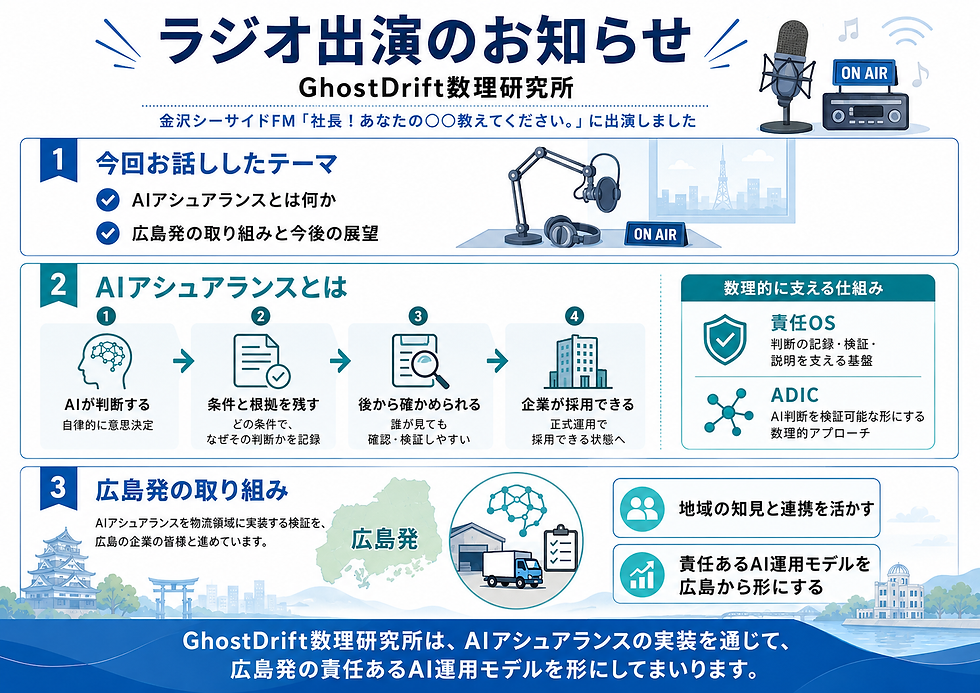
6. Σ₁ Proof Principle (Verifiable Σ₁ Principle / ADIC)
— Return from "Believing" to "Verifying"
GhostDrift does not trust authority or black boxes.
Instead, we provide:
This is ADIC (Arithmetic Digital Integrity Certificate). It records:
What calculations were performed.
Which operations were done correctly within what error range.
Which boundary values fit within the safety margin.
This is recorded as a "line-by-line ledger" that can be checked later.
The important point is:
It is not about "disbelieving."
It is about returning to a form that "can be understood by verifying" before deciding to believe.
By not escaping to infinity and grounding everything in a finite-length ledger, we detach "correctness" from "who said it." This is the foundation of GhostDrift’s "No-Lie Computational OS."
7. Irresponsible Escape Principle
— Detecting structures that shift responsibility to "Infinity"
It is not just in math or control systems. The same problem exists in "structures of words" such as:
Terms of Service
Legal Contracts
Business Manuals
Laws
The problem is:
Examples:
"Shall be decided appropriately according to the situation."
"This service assumes no responsibility whatsoever."
"Details will be prescribed separately."
These are common phrases, but from the GhostDrift perspective, they look like this:
The Irresponsible Escape Principle decomposes these into 6 typical patterns (Infinite Push, Definition Switching, Dimension Expansion Escape, etc.) and provides a formal method to detect "where and what type of escape is embedded."
This allows us to evaluate contracts, laws, and logs on top of the GhostDrift Kernel. It resolves the imbalance where "Only math is rigorous, while text is allowed to escape infinitely."
8. Semantic Energy Principle
— "Meaning" also has a Conservation Law
When GhostDrift handles energy systems (Power, BESS, Renewables), we take a slightly different view from standard engineering.
We do not just stabilize physical quantities like Frequency or SoC. We introduce an index asking:
This is Semantic Energy (Esem).
In GhostDrift, for a system state x(t), we define:
Emech(x,t): Physical/Mechanical Energy
Esem(x,t): Energy reflecting Meaning, Ethics, Priority, Fairness, etc.
And we define "Safety" by:
Simply put:
Direction where Semantic Energy runs wild (E increases) → Signal of Danger/Attack/Collapse
Direction where Semantic Energy settles (E decreases) → Safety/Consistency/Convergence
Here, the division of labor reappears:
This is the "face of the World Model" of GhostDrift, applicable not only to energy but to laws, institutions, community management, and OS design.
GhostDrift Theory = "Finite World Consistent OS Kernel" made of 8 Principles
The 8 principles introduced here are not scattered ideas.
Finite Respect Principle
Beacon Principle
Consistency Principle
Prime Gravity
Finite Closure (Finite Closure + UWP)
Σ₁ Proof Principle (ADIC)
Irresponsible Escape Principle
Semantic Energy Principle
Together, they work as an "OS Kernel to maintain consistency in a Finite World."
Math (Primes, Analysis, ABC)
Energy (Renewables, BESS, Grid Control)
Finance (Risk, Derivatives)
Law/Terms (Irresponsible Escape Detection)
AI/World Model (Semantic Generation OS)
The 24+ patents and demos developed by the GhostDrift Mathematical Institute can be considered as these 8 principles compiled into the respective layers of the real world.
Wasan 2.0: GhostDrift’s "Japanese OS"
Finally, I want to touch on the cultural background of where this theory comes from.
The philosophy of GhostDrift did not appear out of nowhere. In its deep layers, there are "Four Musketeers":
Harumi Shibukawa (Calendar and World Model)
Takakazu Seki (Mathematics as Finite Structure)
Kiyoshi Oka (Semantic Energy as "Sentiment/Jōcho")
Hideki Yukawa (Field and Finite Potential)
We call this Wasan 2.0.
Shibukawa: Ancestor of the Beacon Principle.
Seki: Ancestor of Finite Respect, Finite Closure, and Consistency.
Oka: Ancestor of the Semantic Energy Principle (Harmony through Sentiment).
Yukawa: Ancestor of the Physical Model of Prime Gravity and Finite Closure.
GhostDrift Theory is an attempt to extend this lineage of Wasan 2.0 into a "Consistent OS for a Finite World" for the 21st century's OS, AI, and social systems.
Conclusion: What it means to stop escaping to Infinity
What GhostDrift is trying to do is:
Solving problems while remaining finite is troublesome. Errors and exceptions lose their escape routes.
Nevertheless, we must return:
Mathematical proofs
Computational errors
Energy fluctuations
Loopholes in laws and institutions
One by one, back into the "Finite Box."
We believe that therein lies the reason why the GhostDrift Mathematical Institute exists in this era.
▼ GhostDrift Mathematical Institute: Patents & Social Implementation Portfolio You do not need to blindly believe our words. Check the published patent numbers and the actually running code with your own eyes and hands. https://www.ghostdriftresearch.com/projects-8-1


コメント