
[Official] The Three Core Principles of GhostDrift | Finite Respect, Beacon, Consistency + GitHub Archive (Finite Closure / ADIC)
- kanna qed
- 2025年12月12日
- 読了時間: 4分

更新日:2025年12月14日
0. What Are the Three Core Principles of GhostDrift? — Foundations for Finite Closure / ADIC (Finite Respect, Beacon, Consistency)
When you look at the GhostDrift Theory in detail, you find more than eight principles and practical guidelines. At the very core of all of them, however, lie the following three:
Finite Respect Principle
Beacon Principle
Consistency Principle
These three principles each correspond to one OS-like layer:
“What do we choose to value?” (Value)
“From where do we look at the world?” (Observation)
“How do we keep it going over time?” (Stability)
In what follows, we explain each principle and introduce the corresponding GitHub archive.
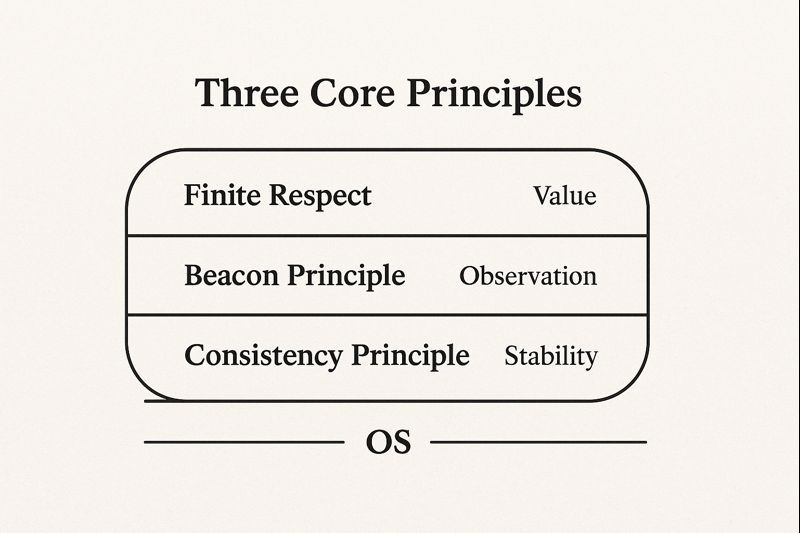
1. Finite Respect Principle
Even what is pushed outside the window continues to carry structural value and responsibility.
The Finite Respect Principle is the ethical kernel of the GhostDrift Theory.
On the mathematical side, the operation of Finite Closure inevitably produces an outside region (the Ghost) that is pushed out of the window. In conventional mathematics and social systems, this exterior has often been treated as “error,” “exception,” or “noise,” and simply ignored.
GhostDrift takes the opposite stance:
Exceptions, margins, dropouts, noise, deviations — these are not “failures,” but parts of the structure.
Precisely because they are outside the window, they carry Ghost-like mass that corrects the inside and updates the world.
To insist on this perspective is what we call Finite Respect.
▶ Corresponding GitHub Archive (Example)
GhostDrift-Finite-Respect-CoreA repository that gathers texts and simple simulation notebooks dealing with the Finite Respect Principle from both mathematical and philosophical angles. 👉https://ghostdrifttheory.github.io/finite-respect-principle/
This repository archives, for example:
Diagrams of finite closure and Ghost regions
Models of data/choices/ways of life that “fall outside the window”
Examples applying Finite Respect to real-world cases (education, employment, local communities, etc.)
2. Beacon Principle
The world can only be constituted by placing a “lighthouse (Beacon)” somewhere.
The Beacon Principle is the principle of observation and reference coordinates in the GhostDrift Theory.
Mathematically, it appears as:
the center of a finite window,
the reference point of a Yukawa kernel,
the observation point at which δ_pos is evaluated.
Philosophically, it appears as:
a declaration of “I will see the world from here,”
the self-determination of “Where do I place my lighthouse?”,
the plurality of worldviews that arises when many Beacons coexist.
GhostDrift therefore insists on the following approach:
do not try to handle an infinitely expanding world as it is;
always place a finite observation point (Beacon) somewhere;
reconstruct the outside as structure starting from that point.
▶ Corresponding GitHub Archive (Example)
GhostDrift-Beacon-KernelA theory-and-implementation repository that collects Yukawa kernels, finite closure, and Beacon placement strategies.👉
Here you will find, for example:
How the choice of Beacon changes the way the world looks
The role of Beacons in analytic number theory (Prime Gravity)
Design of observation points in energy control, security, and meaning-generation OS
These topics are explained and tested using mathematical code and diagrams.
3. Consistency Principle
Keeping meaning-energy from running wild over time so that the structure does not self-destruct.
The Consistency Principle provides the dynamic stability condition of the GhostDrift Theory.
Within GMI, we introduce:
system state x(t),
meaning-energy E(x,t),
attack/anomaly level A(x,t),
and, under conditions such as:
Security(t) = − dE/dt (decay of meaning-energy),
A(x,t) does not exceed a critical threshold,
we formalize, as security and control theory,
“Meaning does not break down” = “Consistency is maintained.”
This becomes a form of GhostDrift-style “mathematics of sustainability” that can be applied across domains such as:
energy systems (power grids, EVs, storage),
financial risk management,
irresponsible-avoidance detection algorithms,
operation of meaning-generation OS / world models.
▶ Corresponding GitHub Archive (Example)
GhostDrift-Consistency-EngineA repository that aggregates modules treating “consistency” mathematically, including the Finite Closure Energy Kernel, irresponsible-avoidance detection, and meaning-energy control.
Here you will find, for example:
Concrete implementations of E(x,t), Security(t), and A(x,t)
Application examples in energy, finance, law, logistics, etc.
Samples of cases that satisfy or violate the Consistency Principle
Through these, we explore how to design structures that do not break.
4. Positioning as Three Core Principles
Each of the three principles is important on its own, but within the GhostDrift Theory they combine as follows:
Finite Respect Principle
What do we refuse to discard?
How do we treat the outside of the window (Ghost)?→ The kernel of ethics, value, and attitude.
Beacon Principle
Where do we place the lighthouse?
From which observation point do we describe the world?→ The coordinate system of observation, perspective, and OS.
Consistency Principle
Does that world remain intact over time?
Does meaning-energy avoid runaway behavior?→ Stability, security, and sustainability.
By aligning these three layers, the GhostDrift Theory functions as a single “world OS” that cuts across:
mathematics (analytic number theory, finite closure),
engineering (energy control, finance, OS design),
philosophy (meaning, ethics, ways of living).
5. Future Development: From the Three Principles to the GhostDrift OS
Each GitHub repository is more than a collection of code. Each one is an experimental field where:
Finite Respect provides the perspective that “what is pushed outside” can be treated as a resource,
Beacon shows how the choice of observation point changes the way the world appears,
Consistency controls meaning-energy so that the structure does not collapse.
Using these three core principles as its nucleus, the GhostDrift Mathematical Institute will continue to publish:
mathematical demos for Prime OS / Prime Gravity / ADIC,
implementations in energy, finance, law, and logistics,
applications to LifeOS, community design, and cultural editing.
GhostDrift Mathematical InstituteLead Researcher: Manny


コメント